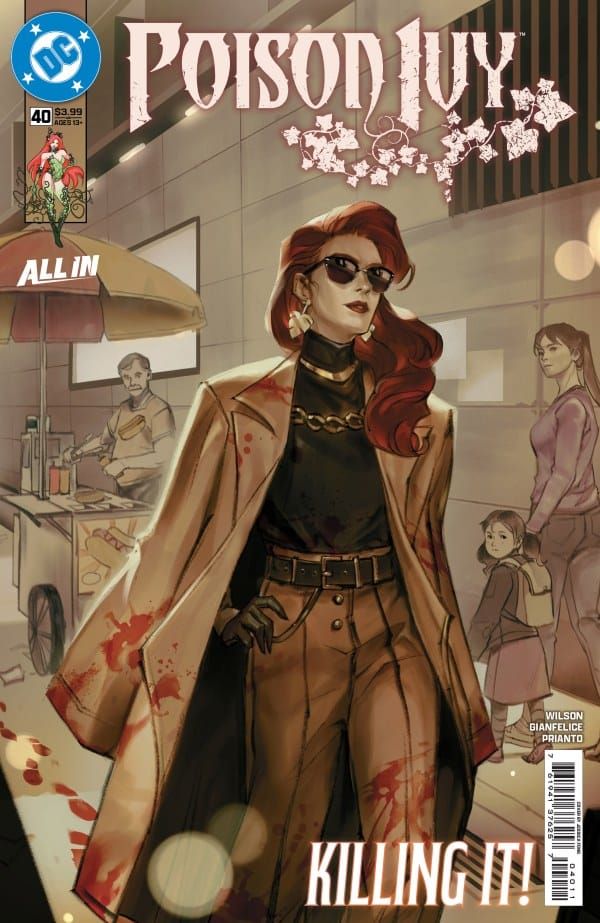
DC’s Poison Ivy at Issue 40: Killing It!
I’ve been wanting to write about the Poison Ivy series by G. Willow Wilson and the talented rotating cast of artists for a while now. I’ve known that the series has impressed me and that I can’t wait to read it when I finally pick up my comics from my comic shop (sorry Luke), but it’s been difficult to come to the page with what, exactly, I find so enthralling. I think, also, my thoughts about this series are complex in their positivity which is always harder for me to write. There’s powerful happenings in these pages that maybe I’ll write more about elsewhere, but for now I want to celebrate on the digital page what it is that’s really pulling me from issue to issue in this series.
As I read issue 40 of Poison Ivy, there was a lot that clicked into place. This issue comes back, explicitly, to the themes and ideas I think the creators are playing with while also doing a great job summarizing the moves that have made me go, “so good” too many times to an empty room. This series has been a stunning exploration of the character of Poison Ivy, developing her in wonderful ways, keeping the character exigent and, honestly, very cool.
In short: Poison Ivy is killing it.
Okay, “Killing It” is the title of issue 40 and while a future version of me will read this and sigh with deep regret, current me has decided to press onward. May the Prophets of Bajor guide me.
While issue 41 and 42 are out already (and I’ve read 41 so will probably slightly comment on it here too), I’m focusing on issue 40 because it also feels like everyone has had time to read a comic that’s a few months old. I really don’t want to spoil people’s fun in reading so this also serves as an invitation to pause, go get out your Poison Ivy comics, and read them before I go vegan ham here.
For those who are not comics people, I’m going to give the briefest, quickest summary of what the series has been like and who Poison Ivy is, so if you are a comics person you can skip this paragraph too. But Poison Ivy is a Batman villain (if you don’t know who Batman is I’m not sure I can help here) that you may remember from the classic 1997 film Batman & Robin were the character was played by Uma Thurman. If you’re really hip and stealing your parent’s HBO password, she’s in the animated series Harley Quinn as Harley’s romantic (and more) partner. At the very least you’ve probably seen someone on Halloween in a revealing, plant-themed costume that may or may not be Poison Ivy but, even if it isn’t, you’re like 37% of the way there to getting the character. In classic superhero fashion, she has powers. Hers are plant oriented with the power to make plants grow, create violent versions of plant-life, control the plant-life around her, etc. Depending on the comic you’re reading, as well, these powers are a little silly or god-like powerful, so I’m being a big vague here to encompass all her permutations.
If none of that helped just throw your hands up and come along for the ride. I promise there’s some good thinking somewhere below. At the very least, this roller coaster won’t result in whiplash (this is not financial advice, I can neither guarantee nor not guarantee whiplash).
A lot of the character’s motivation is related to helping heal the planet and ecological justice. She’s a villain with a goal that isn’t world domination or kill the good guy. Instead she’s on the side of getting rid of pollutants and forever chemicals just with intense violence. Issue 40 sees this version of Ivy come to the forefront as she is using a group that sees her as a figure of inspiration or idolization to blow up an oil company’s office building then get herself arrested to start bargaining with Gotham’s (the fictional city that Batman lives in) political engine. So in this issue we get to see a classic version of Poison Ivy (doing a violence to get a point across) woven with the Poison Ivy that Wilson, et al have been working on creating in this series; a woman who is trying desperately to follow her heart and do what she knows is right.
Talk about a character that speaks to the contemporary moment.
Ivy makes a choice in this issue to hit the oil company where it hurts; data and money. She even makes sure to put Japanese knot weed in the building to further make it difficult for people to repair the building itself, allowing for nature to take over a bit more in this space. In this moment in the comic, it doesn’t look like she’s killed anyone, just destroyed a building which, through the logic of comics and the logic of contemporary *waves hands wildly* seems pretty legit.
It's this making a choice, though, and following through it with that truly fascinates me about this series. Throughout the issues, Ivy is constantly making choices that are involved with the question of “What can I do to make the world healthier?” From a writing perspective, this is just how you create characters: you put them in situations and have them make a choice. Rinse, repeat. So, this makes sense. But, the way that Wilson and the artists do this feels a little heavier, more intentional, and a bit more exploratory than a straightforward moving character through plot.
Since the beginning of the series, Ivy is attempting to fix things. She wants to make the world heal, specifically the natural world. Her first attempt in this series is to go on a cross-country road trip infecting people with a fungi spore that will, she assumes, kill the problem: humans. This includes her. This solution which feels like a more extreme, serious version of the “nature is healing” memes that go around when people stop actively harming their environment, doesn’t work perfectly and is, of course, riddled with the complications of scale, cruelty, a sprinkling of contradiction, and the fact that some humans are actually not that awful.
I think that the first set of issues that are collected in the trade paperback called Poison Ivy Vol. 1: The Virtuous Cycle are well worth your time here, as an aside. Head over to your local comic shop or your library or your local bookstore and snatch it up. Good stuff. If you’re local, happy to lend it out.
As classic storytelling goes, Ivy is changed through her experiences in these early issues, makes new, somewhat better choices at the end and is changed from the experience. If it ended there, as it was originally intended to before the people rose up to rejoice in its brilliance (slight exaggeration?), it would be a solid story about a beloved Batman villain. But it doesn’t end there. And, more importantly for me, it doesn’t continue on as many series inevitably do; as a monster of the week or mission of the week or six-issue arc that doesn’t really tie into things that come before or after so that new readers can jump on (which maybe it does this last one a little). Instead, the series continues to ask the question, “How can we fix this?” The this, of course, being the environmental issues the whole world is currently faced with.
In issue 40, the answer is team up with a terror-lite environmental group and try to extort the local government to make the changes that need to happen for the continued, long-term survival of the human race. But in earlier issues, the answer is different. In fact, it’s constantly different. It shifts and changes and Ivy tries out new things, new ways of approaching the issue or interacts with others who are choosing how to do handle it differently. This searching is what I’m so fascinated by. These options are what makes it so beautiful.
Because before this Ivy is presented with option after option after option after option for how to tackle the issue of ecosystem repair. Sometimes she chooses small projects like when she teams up with Killer Croc (another Batman villain, basically a huge, bipedal crocodile) or sometimes she chooses to completely escape like hiding in a town called Marshview that seems impossible to find. Regardless, since the very beginning of the comic Ivy, and in turn the reader, keep being presented with the same question, “How can we fix this?”
Do we hide? Do we fight? If we fight, how hard? Who do we direct our anger at? Sometimes the question becomes more of a statement rather than a question; something like “How could this possibly be fixed?” And Ivy makes these choices to hide or fight or attack someone or help an individual or deal with her own issues first or to eat the person who turned her into Poison Ivy in the first place (yea, superhero comics are great). Each time, no matter what she chooses, there’s the proverbial brick wall that stops her. Very little actually changes. Though, importantly, changes do happen.
This, on the one hand, is narratively what needs to happen for the series to continue. There is no solution because next month there’s another issue and another after that and we’re coming up to almost four years of issues at this point, that will continue to go on. There needs to be continued conflict. Will the comic just be Harley and Ivy having tea in the mornings while we see others heal nature? Honestly, I’d buy that.
But while this is a limitation of the medium and genre that the story is working in, Wilson and the artists lean into it. What can you do with a series that, seemingly, has no planned end point? You work with what you’ve got. And what they have is a character who, like many of their readers, is hit with this nagging, awful, repetitive, mind-numbing, rage-baiting, imperative, impossible, needed question; How can we fix this?
For the reader, seeing Ivy attempt to answer this question could do many things, all of which keep drawing me back into this series. We can view this as options. Wilson, et al are giving us fictionalized pictures into what it means to be an ecoterrorist or to run away from your problems or to fight one corporation. It provides a way for us to ask, “What would I do in that situation?”
It can act as a way to understand, potentially empathize with, how difficult it is to actually do this work. The comic does a wonderful job at showing how infinitely complex it is to make real change when whole systems are woven into each other so tightly they seem to hold water, even when you have the literal power to grow plant life in any place. A great example of this is in an earlier comic where Poison Ivy has a flashback to meeting Batman early on in their careers (is blowing up oil rigs a career?) as protagonist and antagonist. She seems in him a kindred spirit. Someone who isn’t afraid to do what needs to be done, regardless of the law. But, in this moment, Batman doesn’t trust her, assumes that she’s “manipulating” his feelings in some way, then brands her villain.
Honestly, this is one of my favorite moments in the comic which takes a lovely critical view of Batman who, even though he fights against people who are hurting others, cannot see beyond the system that provides the means for him to do so. He’s so entrenched in it that any suggestion from Ivy that the system itself needs to come down (remember someone’s gotta pay for those fancy jets and cars Batman drives around) that he cannot believe she wants to do good. He also seems pretty convinced that Poison Ivy is hot and hot people, especially women, can’t ever have good ideas. Holy yikes Batman.
The series also acts, partially, as invitation, though I’m sure that the creators would not say so on account of all the violence. But, taking into account that the violence and the punching is another convention of this genre of comics, maybe it isn’t too farfetched. There are examples of small ecosystem restoration and connection with people also trying to survive. There’s helping neighbors. Organizing. There’s options here that ask, “What would you do?” to the reader.
Savvy readers will note that I’ve described the windows, mirrors, and doors way of understanding different books here and intentionally so. I think that the Poison Ivy series is playing with this in intentionally brilliant ways that invite us in as, maybe, co-conspirators? Or allies? It is not, often, inviting us in as spectators as a lot of comics do. I mean, yea, we’re reading the art and the art is often incredibly gorgeous (it’s so flipping good most of the time), but I believe the series, by asking this question intentionally, asks us to do more.
These options and trials that Poison Ivy goes through, truly inhabit a special place within serialized comics narrative. As readers we get a story that is exciting and stunningly beautiful that also pushes us towards a deeper understanding of ecological justice. The ways the comic tries to bring us into that conversation makes it truly great. I do want to address one more part that happens in comics series that go through a lot of issues. There are always narrative off-shoots or moments that feel disconnected, maybe editorial interventions or the digressions of the writer/artist, that I also want to address here.
While there is this narrative push to have Ivy actually try to figure out how she can best fix ecological issues, there are side characters or sub-plots that get played out throughout the series. I think that these are easy to read as visual candy or, maybe, page filler and it’s completely possible that’s all they are. I do see, though, a way that this series utilizes these “filler episodes” or pages, in unique, powerful ways.
Issue 40 incorporates a scene with the new police commissioner of Gotham, Vandal Savage*, who is ruthless in physically assaulting Poison Ivy. It’s also stated that he’s encouraging the Gotham police to do major police violence against every “criminal”. The issue also introduces a character using AI systems (broadly defined here though clearly connected to contemporary usage of “A.I.”) to track, monitor, control, and terrorize the population of the city. These two moments are similar to many other moments in the comics where Ivy is set up against things that don’t seem to have much to do with her ecological mission, but are inevitable roadblocks in her way.
Sometimes, these issues are smaller like how Ivy gets mixed up with the character Janet from HR. Janet and Ivy have a romance that is then put into a larger conversation around Harley and Ivy’s relationship (minor spoiler: Harley and Ivy have an arrangement) for example. These moments of romance or potential digressions, like when Ivy ends up killing a terrible boss in a shipping warehouse, can feel like they don’t fit into the greater narrative. I’m sure not everyone likes them or wants them in the story at all.
Issue 40 makes explicit, though, how these things are connected and how solving one thing means dealing with many more. The issue of police violence can’t be separated from ecological disaster. Because, here, the police are using a technology that has been pulling water from an underprivileged area in the city so that they can then terrorize that specific population of the city. There is no green space because of the implicit racism and classism on display in this issue. Poverty, housing, systematic racial discrimination, sexual violence (this one not in this specific issue) are all intertwined with ecological justice.
For me, these digressions speak to the larger questions being asked by the series. The moments of interpersonal connection, how characters express desire at the end of the world or in terrible situations, is what we are doing now. In the face of the terror we live in every day we still love or hit on people or find connections in unlikely places. And it’s these connections, the ways we deal with the intra- and inter-personal, that also effect how we decide to answer the “How do I fix this?” question. Our connections with each other are also woven into the system we are trying to unravel.
Small note here: I find it incredibly important that Poison Ivy is not only queer, but that she has an open line of communication with her partner where they’ve clearly discussed what the boundaries are in their relationship. While others might find this a way to tantalize, I find it another way that the characters are moving against hetero, monogamous, dare-I-say white supremacist expectations that are often tied into the larger issues discussed above. Again, this series really makes hearts float above my head at all times.
As we come to the close of issue 40 where Ivy is given a non-choice to support the establishment by coming up with a way to justify the theft of water the police are using to power their oppressive technology, we are set up with another one of these choices I’ve been raving about. Ivy can, simply, choose to cooperate or not. There are infinite variations of how she can do this, but these are the two directions she’s given. But, when the people she loves (Janet, Harley) get threatened by the woman who runs the AI program being used to terrorize the populace, Ivy chooses to murder her instead of play ball. I’d like to say that’s not the choice I’d make but I don’t know. It’s 2026 and we’re all fed up.
It's this that keeps the narrative going into the next comic and will keep this character going through many more issues. It’s this outline of story that, I expect, the series will keep following. Never giving us a direct answer. Never saying that this, this right here is the solution. Instead, it suggests that there are many solutions. Or a hierarchy of solutions. Or that the problem is something other than what we think. Or that a solution isn’t what we should seek.
At the end of it all, I love the Poison Ivy series because it is artists working through things. It’s a writer and letterers and inkers and others trying, like all of us, to make sense of the world we have inherited. Trying to make sense of what our place is in it all. How we can save it, keep it functioning enough so that our children can have it too.
It’s a story about a woman who can control plants but is painfully human. So, gorgeously human.
* Okay, I’m going to take a minute here because putting it in parentheticals was too unwieldy. So, if you know who this is then: why? What did I miss? I missed so much obviously. If you don’t know who this is, it’s another huge villain in the DC universe. Like he’s an immortal egomaniac that the whole Justice League fights sometimes. So, suffice to say since I only read Poison Ivy and not any other Batman comics, I was a human question mark. He’s a big bad. He’s a monster of a villain. So, they made him a cop. Read into that what you will.
Thank you for reading! If you enjoyed this, please share it with others and let them know that I do a monthly essay/review/thought/rant every month. The kind of things I talk about are always shifting (next month with be an audio book about healthcare!), so there's something for everyone. It will always be free to read.
If you're so inclined to help keep me drowning in books, you can do a one time donation at the link below or subscribe for a small monthly donation.
Thank you again!
 About the Author