Understanding How I Make and Think About Art

It happens every May. I feel my body transitioning from one that sweats in overheated classrooms and talks about audience, the rhetorical situation, and the benefit of turning in things before the end of the semester to one that stares out a window into the bright green of the world thinking about how much I will sweat if I venture outside. I do venture outside eventually, though the outside doesn’t seem to like me much. I burn even with sunscreen, every time I’m outside a bug flies into my eyes or nose or ear or mouth, I sneeze violently when the sun touches my face for the first time, and did I mention the sweating?
Okay, my reaction to the summer is a little whiney (expect for that bug thing it’s wild and I hate it) but it is often a rough transition. One where I’m moving from working constantly to one where I don’t have to work as constantly. I still work during the summer but those hours are more self-guided, and since I haven’t had to scrounge for work (read: beg to work or drive DoorDash) to pay the bills for the last couple of years, it’s been less stressful and panicked. I feel very lucky.
Really, the summer is time for me to write more, which often gets neglected or tossed around from September to April, but I take large steps forward during these summer months. I’m trying this year to lean into my aversion towards heat and sun (as well as my aversion to using my car for anything at all), allowing myself to spend some dedicated time writing and creating (and of course reading but I try to do a lot of that always).
This means I’m thinking deeply about my artistic practices, trying to figure out what is working for my body now rather than last year. Trying to find the space that will allow me to finish a couple fiction pieces, take another look at my poetry manuscript, finish drafts of so many poems, write some posts for Widely Read, and work on some other nonfiction I’ve been dreaming about. It’s time when I can try some new things and experiment.
Because my mind is on the possibilities of what I can create, I seem to be drawn magnetically into books about writing or art, along with conversations about how others do it. I truly am obsessed with people talking about how they work on their own writing or how they think about artistic expression or the reasons why they create. It feels a little like watching how sausage is made but maybe slightly less disgusting. I’m hyper aware, then, about anyone else talking about art so I was pleasantly surprised at how one conversation around art and artistic creation, Scott McCloud’s seventh chapter in Understanding Comics, passed through my life in three different ways.
First, I finished rereading Understanding Comics, specifically the last three chapters which I didn’t talk about in depth with students this semester. Though I had read it before, I always like to finish books that I read all the way through. And I purposefully didn’t have this specific class read chapter seven because I like to talk about it and because it didn’t overlap with what we were covering in the class. Second, I saw that Sequential Scholars, which does short threaded posts about different comics, was covering McCloud’s book specifically. They’re always wonderful and because I was finishing the book while seeing this it felt uncanny. But the final thing that crossed my path was a post on Bluesky by Spike, the founder of Iron Circus Comics. In this post, part of McCloud’s book, a section of chapter seven specifically, was pointed out and connected to conversations that have been happening around people who use generative AI (image-generators and LLMs specifically) to plagiarize other people’s work then call it art.
The comment was about McCloud’s outline of a six step “path” he claims every artist goes through to create something. The six steps are 1. Idea/Purpose, 2. Form, 3. Idiom, 4. Structure, 5. Craft, and 6. Surface. The image that Spike shared was the image below saying that it was a perfect example of how it feels reading LLM created visuals or writing. I was excited about this because it unlocked some thoughts that I want to share here, but also led me to think deeply about ways that I’ve spoken about this section of McCloud’s book in the past.
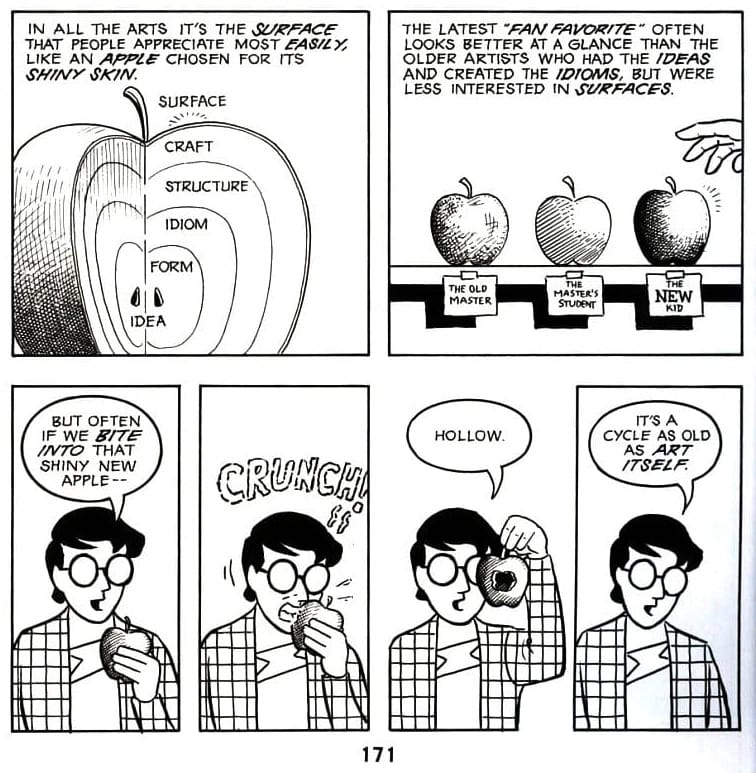
What I like about connecting “AI” to the metaphor of biting into a hollow apple is that is all LLMs and image generators can do. It’s all they’re programmed to do: create a surface level. Or, more exactly, create something that looks like something else from a distance. So there is no consideration of craft or structure or form because the program is created to guess what the next word is most likely to appear after the word it just generated. There’s no meat or seed to it because it stole an absolutely stunning amount of language and visual data, then puts an equation behind it to organize that stolen info. It is all surface.
I really do like this metaphor and find it incredibly apt. I also find that it overlaps with how I usually talk about this chapter in Understanding Comics. Typically, I use this book in an Introduction to Comics class and have found that it is incredibly useful, especially for students who have little to no experience with comics. Many of my students find it a wonderful starting point and I find it incredibly valuable in that context.
Throughout the conversation my students and I have of the book, I encourage students (as McCloud does in the book too!) to disagree with his ideas or challenge them. This has led to too many wonderful conversations to list here but the “path” he outlines for making something is one where I come in to model a kind of disagreement. Pedagogically, this is a way for me to introduce critical conversations on the texts that we read and how to ask questions. Creatively, I disagree with McCloud’s analysis of how creating something goes. And this confluence of using the metaphor of the hollow apple as what these generative machines make only made me think more deeply about why and how I disagree with this idea.
(Here is where we move away from convos about AI quite a bit and into actually artistic expression and creation, so thanks for sticking with me through the rightful hating on these programs. May the bubble burst and may many of the people selling these “tools” see jail time.)
When I bring up this chapter to my students, once we get past some of the more easily to critique sections of this chapter (including the man chasing a woman to “reproduce” but clearly it looks like sexual assault), I ask my students to consider if anything they create is just surface. Can they, in fact, create or build or draw or make or write or bring something into existence that is merely surface? Is there a way to produce something that doesn’t consider form, idiom, or craft? Can something be created without an idea/purpose?
I argue that we cannot create something without the other parts of the path McCloud outlines being present, specifically the “idea/purpose” part. I want to repeat “argue” here because that is what I do; I argue that this couldn’t work. I think McCloud makes a different point and one that I’ve heard students, as well as others, agree with in part or fully. I think this is fine. It isn’t something that I find abhorrent or ill conceived, merely a position to take on this. I disagree.
First, I don’t find this idea extremely helpful for teaching or for analyzing comics in particular. Students are already beating themselves up over not being perfect artists or creators of knowledge while also being inundated with a pop culture that laughs at them if they’re creative, demeans their creativity if not used for financial gain, while existing in a world that explicitly punishes us for creating by devaluing the worth of artistic creation, not funding it enough, not funding education. Ya know. The current state of affairs. It’s not great. Adding a claim that creating can happen without thought or depth, even for college students, can be more prohibitive than not. This alone is a good enough reason to argue against this path.
Second, I think that the idea of “surface” level work is often levied at the things that do gain popularity for whatever reason and used to dismiss things that are popular as “not worth our time” or simple. This happens often with popular work created by women, people of color, poor people, and other oppressed groups, more often which is just a hell of coincidence huh?
In addition, it devalues things like romance or fantasy (or comics!) as genres that are only “surface”. They’re pretty. They don’t think. They follow a formula. Whatever the criticism may be. While also overlapping with the first point (which is that this feels unhelpful at best), this is lazy criticism. YA novels aren’t good because they’re “only surface” feels like saying burgers aren’t wonderful because you could purchase them frozen. It’s nonsensical. It also creates a hierarchy that’s helpful for those who don’t write within those genres or who don’t find immediate success. “I’m just deeper than the other books with dragons, that’s why it’s not selling.”
Even romance, which people love to hate on, deserves recognition and thought for how it deals with form, idiom, purpose. Even choosing to end a book with a happily ever after is still a choice. It means something. It signals something to the reader. It comes from a specific idea or place of what the book may be thinking about or arguing or presenting. There is an idea there and there is form and structure no matter what.
Really, the thing that I find most important to highlight here, and do so with my students, is that there is always an idea/purpose when a person decides to create something. Even if taken to the extreme, a kind of “I will write a poem without an idea/purpose,” that becomes the seed (again using McCloud’s metaphor of the apple) of the piece. The purpose or idea can be expressing an emotion, getting back at an ex, dealing with a mental health crisis, making a child giggle. I mean the possibilities are absolutely endless as art is infinitely endless. Even work that isn’t on a “professional” level, here I’m thinking very much about drawing/visual art though it can apply to many different types of artistic creation, still interacts with all the steps on the path that McCloud outlines. The depth or breadth of that interaction may be limited but that isn’t “surface”. There’s still things there, there’s still choices being made, there’s still expression and creation and meaning and all the beauty that comes with deciding to actually create a thing then share it with someone else.
Because a human is making it, there must be a seed. There’s also a long line of trees and other apples that have influenced that new creation. The surface cannot exist without the seed telling it what it should look like and feel like. I may have gotten lost in the metaphor here, but the idea/purpose part, at the very least, is present in anything created, no matter how amateur it may be.
Third, I think the idea of the “surface” level of creation offers a shield for certain popular art to hide behind. How can we think deeply about something in pop culture or something that was created “just” to entertain? “The movie isn’t that deep man. You can’t say Tony Stark committed genocide because he killed all the people of a race that was helping Thanos. It just not THAT DEEP bro.” Which, obviously, is made up and not a conversation I actually had.
Like I said above, the idea of a creation being only surface allows us to avoid recognizing that it exists in a time and space and culture and world that has meaning and makes meaning. Fourth Wing is only surface so it doesn’t matter that the main character’s disability goes away after she works out hard enough. Super Mario Bros Galaxy is visually beautiful so saying it’s a marketing scheme disguised with the label of “movie” is silly. You get the idea.
But this is also where a creator can hide. Well, you’re thinking too deeply about how I described that woman coming down the stairs, that’s just how she does it; boobs first. That’s how that character looks, it isn’t racist! Explosions look cool, what does that have to do with the hundreds of thousands of dollars I received by the military? Again, you get it.
The idea that we can create a thing with surface only (again there’s that little word “idea” which I typed and then giggled to myself and was like, look at me just believing in myself) means we can create without meaning or depth. Our choices are only for the shine of it. Delving deeper is a waste of time, thinking critically is pointless. Just let it be.
This thought process is, in my opinion, the mark of someone who isn’t fully experiencing what it means to be human. I’m tempted to say this is child-like, but that’s not fair because plenty of children can identify choices being made and think about why. Sit with a kid coloring something that looks abstract and let them spend an hour explaining how it’s actually all their friends from school. It is, though, a kind of ignorance. One that, if I’m being generous, comes from being incurious or busy or unable to engage with any sort of art. But, I think at the heart of it is a dehumanizing choice. One that sucks curiosity and joy from a person until there’s nothing left but canned phrases someone else asked you to say.
What I mean here is that the idea of having a surface only piece of art that you’ve created (or one that you’re interacting with that someone else created) leads me to think about who would benefit from art that is only surface or even the idea of there actually being a piece of art that’s surface. Again, I don’t think a person can create only surface, but clearly the idea of a work of art being only surface does. So, who would want to think this? And the only thing that I come to is people who are interested in control or silencing specific voices. It also feels vaguely helpful to those who may want you to ignore the explicitly white supremacist car decals to only react with, “Awesome skull!”
To be clear, I don’t think McCloud is supportive (or was supportive at any time) towards the rise of anti-human thinking or dehumanization as I mention here. The idea that things are simple or straightforward or not deep, has persisted for as long as art has. I don’t think everyone who thinks that some things are not deep and are not worthy of critical thought/conversation, is actively dehumanizing others. But I do think that the people who want to dehumanize us, to see other people as objects, to view ourselves as objects, to lay down and accept that we would have to purchase thought, don’t push the idea of looking closely or critically. They push the surface.
Finally (yea we’re still in a kind of countdown or list, wild), and I’ve toyed with this idea above without explicitly stating it, if we take the idea of the “surface” and stretch it to its conclusion or interrogate it in any way, it doesn’t hold up. If one sits down to draw Wolverine (as the example in Understanding Comics has a kid do) how can it not have an idea? Or an idiom? Isn’t the kid making choices? Isn’t the kid acting in some way and thinking while drawing it out? Aren’t those lines which you talked about having deep meaning like two chapters ago, mean something about his internal life?
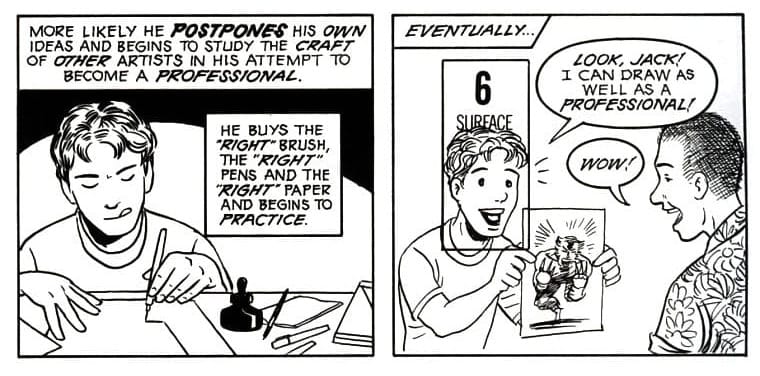
For me the question that I posed above and come back to with my students, as well as myself, is this: How can any of us create anything without an idea/purpose? We splash a little extra thyme in the soup because we know our partner loves the taste. Our pen slips and we add it into the whole. Or erase it. We choose the word “slips” instead of “mistake”. We think about it even if it’s something random. Pulling it to the extreme, even if you find something on the ground while walking and you glue it to a canvas, there’s an idea there. You roll a die to choose words. You had an idea. I can go on and on but I struggle to find something that is actually, really, truly surface that is created by a human being. And by struggle I mean, I can’t. I can’t find something created by a human that does not have purpose or an idea or both.
We have thoughts and feelings and beliefs that affect the choices we make while creating. Hell, even the fact that we decide to write something or draw something is only made possible through our existence and thought. The possibility itself of putting words together and calling them a poem is something that only happens if we are connected to a greater whole, a web of interconnected decisions and artistic expressions that inevitably run all the way back into the beginning of our existence.
(My heart is racing. Deep breath. I love talking about this shit.)
But I think that this is important because the idea that something can be surface is the idea that we don’t have agency. That we can create without the intention to create. Even if we choose to remove intention in some way, getting really wild and experimental with it, we’ve made that decision. It’s like the saying that choosing to not be political is a political choice. Choosing to remove choice from artistic expression is still a choice in artistic expression.
So when Spike compares the empty apple to the LLM, I actually see a possibility for surface. The program doesn’t have the will that humans do. It is a machine that machines in a way that might be impressive or even seem magical to some, yet it’s still a machine. It, literally, randomizes tokens to put one word in front of another without knowing what will come later, only what is before. It gets these patterns from being told by humans who have been dehumanized into believing that art or creation is merely a string of words or a smattering of color stolen from those who still dream. Instead, it’s creating an empty, polished apple skin.
Nothing a human creates can do this. The interior may be rotten or mushy or spicy or liquid. The seed could be small or extremely large or borrowed from someone else or look strikingly similar to an avocado with googly eyes. But, always always always there is something underneath the skin. Something informing the creation, effecting it, shaping it, moving it, making it that is partially in our control and partially not. Creating is the act of trying to make something internal, external. Something unknown, known. It’s the paradox that on the other end of the painting is a person(s) trying to help you see what they see, help you conceive what they’ve conceived. It’s the imperfect and only way that we can say that I too experience things inside myself that only I understand. That I, too, want you to understand.
There cannot be only surface because there is a person creating, reaching out into the impossibility of pure understanding. There is intention to the creation and, inseparable from it, the unintentional. What we mean and what we don’t. The time and space and context of it that sometimes gets transmitted and sometimes doesn’t. It’s everything. It’s life. It’s full.
There is freedom in knowing that I can reach out to someone and attempt to explain to them what is me. It’s scary that I might be misinterpreted or that I said something incorrectly or not in the way I wished, that I may be rejected for baring part of myself in writing (my chosen medium of creation). But that’s why it isn’t hollow, empty. I have, by the mere act of creating this short essay, sent myself with it. I couldn’t not.
I can see, even now, that some might take some of these words and shift them or pull at them until they fit the shape of an LLM like stretching a junior high gym shirt over my adult body. How beautiful that you can move language in a way that makes you feel something. The machine you seek to defend could never be as wonderous as you.
So, I’m going to head back into some poems and stories I’ve been working on. I’ve also been doing some white out poetry and art which I’m looking forward to sinking deeply into. I’ll probably draw with my kid and dance a bit. Yesterday I screamed in glorious joy at the sunset. Because I want connection. Because I don’t know how else to live. Because I like a shiny surfaces and dull one and I can’t wait to take a bigger, deeper bite.
Thank you so much for reading! As an extra treat, please enjoy my short story, "The Line", which was published this month by Penumbric Magazine. It's my first short story publication and I'm super proud of this weird tale of futuristic healthcare. Please give the whole magazine a look.
If you liked my writing above or want to help me buy more white out since I'm running low, please feel free to donate any amount using the link below or subscribe for a monthly update! Subscribing is always free.
 About the Author