We Could Give People More Money: A Review of The Age of Scientific Wellness by Leroy Hood and Nathan Price
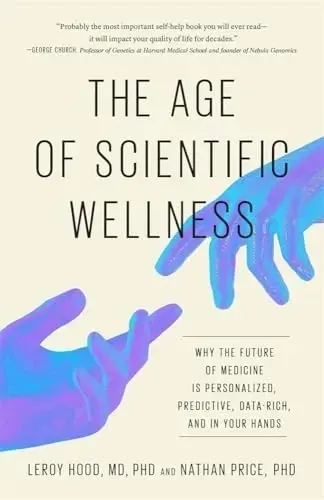
I didn’t want to write a…review? criticism? of The Age of Scientific Wellness by Leroy Hood and Nathan Price. I thought about it before finishing the book but all I could think about was how the book didn’t think about poor people enough. Or, maybe, that they didn’t consider capitalism closely. Or systems of oppression. And I imagined they’d rethink their chapter on “A.I.” in 2026. That was it really. It was more of a social media post than a longer thing.
But it kept nagging at me. I kept mulling over the book and thinking about how it does so much to explore a different way of thinking about healthcare and life. I mean, it really does try to propose a shift of thought from care after to care before. Yet, for all their imaginative leaps they don’t discuss healthcare from a place that actually exists. They justify a vision into the future (one that is compelling to be sure) from a fantastical place that I have never seen inside any doctor’s office.
Okay, I’m slowing down here. Truly, my desire to write about The Age of Scientific Wellness comes from the deep interest I have in the ideas presented along with deep confusion on how they could have missed such large, obvious complications. I also want to consider this text more since it does seem like Hood and Price seem to honestly care about making people healthier. My goal isn’t to be cruel to the book but consider a more expansive view of the issues presented.
I think it’s important to note I’m not a medical doctor nor am I a scholar/journalist who studies medicine in depth. I’m not qualified to discuss whether their ideas would work or are even good medical practice. The ideas sound attractive. They’re explained well in the book. But, I am writing this as someone who lives in the US and has had healthcare provided to me with and without insurance. I’m writing from a few other lived experiences as well (poor, white, male, fat, mostly able bodied) that effects this reading in specific ways, but mostly I’m approaching this as someone who isn’t deep in the weeds of it all. I’m writing as an outsider, which is what I think they needed desperately.
The Age of Scientific Wellness, as a whole book, takes a look at our current healthcare system and says it doesn’t work well which is like saying the world is round; you don’t get a ton of evidence-based disagreement. But, they specifically argue that the healthcare system should be thinking more about what they call “P4 medicine”. P4 stands for predictive, preventative, personalized, and participatory medical care. It felt a bit like the 3R’s I had to learn in grade school and has the same nice ring to it.
This method is more about thinking about prevention of illness rather than the current system which treats us when something goes wrong. The authors advocate for a proactive method of dealing with our health rather than waiting until someone falls ill and then trying to tackle the problem. For the most part, this all sounded pretty straightforward and wonderful to me. The idea that we should focus on preventative care seems logical as well as encouraging people to participate in their own healthcare sounds equally smart. Adding in the idea that healthcare would be predictive and personalized really spoke to me too. As a person who has had their weight used as an instant diagnosis for things from anxiety to a broken collarbone, the idea that healthcare could be personalized to me sounds genuinely life-changing. It’d be great to not have to remind my doctor and nurses that BMI isn’t a helpful or useful measurement.
When proposing P4, which is essentially the book length project here, the authors do make a solid effort to consider what this would look like and what would be needed to have this idea practically work. They make clear that predictive and personalized would mean a hell of a lot of data about your body being collected. They also recognize that the current place we’re in politically (this book was written before the current administration and the boom of LLMs so there is, at least, a thousand more things that are in the way) isn’t prepared for that kind of information moment.
Still, the idea that if we map enough genomes and have information about enough people we can truly try to tackle issues that surround healthcare rather than what they call “sickcare” (i.e. the current state of the healthcare system) sounds as revolutionary as they claim. Who doesn’t want the best information available on how we can treat our bodies so that we can live longer and live healthier for longer (which is a big thing repeated throughout the book)? It sounds wonderful.
This is the time when I admit I was highly skeptical while listening to this book. There were many times when I swore that these authors were going to start suggesting that I juice celery every morning after rubbing jade across my face and chest. But, often, these authors came back to evidence and explanation rather than nonsense. Both of them seem (again not a medical doctor so would love to hear someone else talk about their actual ideas around P4) to take positions based in rigor rather than conjecture. Their willingness, as well, to call out nonsense in the book and, more importantly, to note that there are issues in the way of what they want to achieve, lent itself to convincing me of their credibility and kept me from moving on to a different book. They were intelligent and seemed very kind in their writing, which I hold to high regard when talking about healthcare, yet they were still realistic about what the limits are to what they wanted to achieve. Well, mostly realistic.
First, and this is something I’m going to give them a huge break on because of the timing of when they wrote their book vs the time it appeared in the world, their belief in AI systems as a viable future technology that will help change things feels misguided at best. While I understand that machine learning and large language models (LLMs) and image generators and the program that tells the bad guys to attack you in your video game and Elon Musk’s machine that made tons of child pornography that I guess is something we are just collectively moving past are all labeled “A.I.”, their conversations around it feel, in light of all the information now out about them, unfortunate.
I think that if I read this book before the last two years of chaos that LLMs in particular have brought to my life, I would have also been sold on the ingenuity that the authors have also been sold. But, having had to do more research into generative AI and it’s difference from other AI systems, it’s pretty obvious they were sold some marketing ideas and ran with what it could mean. Again, I don’t really blame them here because if there’s technology that can sequence genomes faster and more efficiently than what Leroy Hood originally did as part of the Human Genome project, why wouldn’t you be excited about that possibility? It’s just also clear, now (and I think some would argue even then), that that same program is, at best, owned by a company that believes in eugenics or want to take your data and sell it to a government police force hell bent on moving their Nazi cosplay into real life. Remember kids: always melt ice!
Beyond this, as I continued to read, I assumed that they were about to talk about issues with data collection or income inequality or racism or a myriad of different things that are socially or culturally connected to healthcare. I was convinced, and still am, that if they spoke about, for example, the ways in which black women are fairly often misdiagnosed and mistreated by medical doctors, it would support their argument for a better healthcare system. I felt like examples like these could radically help their argument if they would include them.
The example I pulled in the paragraph above, I think, is a good place to start because, again, not a medical doctor, yet I’m very aware that the healthcare system does not treat all bodies equally. In some ways, as these authors explain, it shouldn’t treat each body the same as each body is different. But, what I’m talking about is how assumptions by nurses and doctors, the same flawed humans we all are, lead to unhelpful or dangerous diagnoses instead. Specifically, the example of how medicine has treated different oppressed groups in the US (from women to indigenous to the all the intersections between, above, below, and to the side), is rarely mentioned in the book.
While I can see an argument that talking about discrimination or stereotypes in medical practices would lengthen this already long book, it is a much larger issue than the space these authors give it. Mainly because it hits all four of their P’s. If you are going to be predictive then you need good data to base those predictions on which doesn’t yet exist for many of these groups because of racism, sexism, classism, etc (explicit or internalized). To be personalized and preventative you’d need this good data but also you need a, I will argue, deep understanding of racialized/gendered/queer/trans/etc. medicine to get you there. Without that knowledge, the personalized in particular falls flat on its face. If you want it participatory? I mean, I don’t know how to even start a conversation around that that isn’t decades into a future that sees every assumption about these bodies flipped yesterday.
We don’t live in a space where any of this is possible in the future because the present doesn’t meet the basic outline that the authors assume.
I want to backtrack again to say that both of these authors seem to care deeply about the issues surrounding healthcare and I can already hear their voices argue that some of the solutions they provided do start trying to tackle these issues. I concede that this could be true and I can see how many of their points could shift to include this. But they didn’t in the book. I think they could have, but they didn’t explicitly do so. What is a medical revolution if you cannot see beyond the genome you’re mapping into the social structures that genome exists in? What is the revolution if you don’t explicitly mention that which often goes unspoken?
The inability of this book to look beyond the medical science became glaringly obvious to me as the chapters rolled by and I kept saying, “Oh, this is the place where they’re going to mention that if we literally gave people money it’d fix it right?” I imagine if you’re reading this I’m not going to get much push back on the “give people more money” argument generally but let’s imagine you’re suspicious at least. How can more money actually help your health? Now, here I’m going to pull from my extensive experience playing medical doctors in not one, but two high school stage plays along with almost four decades of actually going to the doctor.
If you have more money you can (in no particular order): purchase better healthcare coverage, feel more confident in your healthcare coverage, go to regular checkups more because of healthcare coverage, pay your bills, purchase food that is healthier, purchase time in which to make that food which could mean working less for example, purchase a gym membership, have more time to walk, pay your bills, lower stress levels, lower anxiety levels, increase ability to care for those around you, relax more, pay your bills, relax at all, enjoy a hobby, actually speak to your child, have a child, have two children, pay your bills, buy a home, have shelter generally, hug a tree, meditate, find your true love, overthrow capitalism, pay your fucking bills.
Honestly the list goes on and on and on. But paying your bills is really right up there with obvious connections to your health like “drinking water” or “sleeping”. Universal healthcare or single payer healthcare could easily tackle so many of the issues they’re claiming P4 medicine could tackle (or it would be a great step towards it!). I believe they do mention this as something they’d love but not enough for me to walk away with it deep in my memory.
Beyond this though, the simplest, easiest solution to all their problems is give people the money. That can be through a radical redistribution of wealth or a plan to have employers steal wages less or a large minimum wage or or or or or or to infinity that are never, not once mentioned. There is no mention of the fact that having more money today, right as you’re reading this, would help. What? Why?
Would the authors like me to participate in my healthcare more? Actually give me the time, space, and finances to do so. The reason some of us don’t participate is because we can’t or it would mess with our jobs too much. I literally work a job where I don’t have to be in an office two days a week and it’s still hell finding a doctor’s appointment that fits within any time during those days. This might not be a money thing to be fair but it feels like a money thing.
Do you want it to be personalized? Why would I if I can’t trust the billionaires who own the companies and are stealing their own children’s tears to try to stay younger longer? How can it even get personalized if I’m not participating? Give me more control (money) over my own data and the ability to monitor it.
Do you want it preventative? Hell yea you do! What about the preventative care that happens right now that is mentioned over and over in the book that I cannot actually do because I cannot afford to? I mean, there’s no way it can get more preventative when you’re leaving hundreds of thousands of people in the US out of the loop with what would be actually preventative.
Do you want predicative? I can predict it now: poor people die sooner than rich people. The prediction will not change unless money gets redistributed in some way. Do you think that Polymarket can let me bet on this?
As the book went on I was honestly shocked that there was never a mention of something, anything related to the wealth gap or a redistribution of wealth because it is the simplest solution to so many of the problems that they claim to care about. It reminds me of conversations with colleagues or students in the STEM fields and a push to rethink STEM as STEAM (the “a” standing for art) that happened some time ago. Would it have helped this book to have approached someone, anyone, who interacts with humans in a non-strictly scientific way? Absolutely.
As a deep lover of science and all the beautiful things it can do, without a context in the human or without a look inward at its own biases, it cannot hope to make progress or even discovery worthwhile. It’s fine if a person is best thinking about the numbers or the shape of a thing or the method to get a damn good answer, but that’s why you get a beer with your friend who’s a plumber and writes thrillers at night. Or the playwright who works in the warehouse. Or the poet. Or the romance author, the painter, the photographer, the landscaper, the insert thing here. I mean, I get it, I know poets who are terrible and would not help here, so not every poet, but you get the idea. Speak to people who interact with people more.
This conversation feels so similar to the one I had at a wedding recently when talking with another college instructor who taught in the health sciences (I cannot remember if it was nursing or nutrition but it was the sciences part of Liberal Arts and Sciences) who was shocked when I didn’t agree that spelling and syntax where the things we should worry the most about in a student’s writing. They could only see the technical, I wanted them to look at the organization or thinking or argumentation or effort.
Which is to say that I feel like The Age of Scientific Wellness could have benefited from a third point of view. One that asked what could be done now? In the next month? The next six? What steps would we need to convince people that this P4 thing is worth it? And to be a proverbial monkey on these author’s back saying, “Could we just give money away? We do it to the wealthy all the time. Why not?”
This third person could have also asked them some solid questions around their infatuation with AI systems or their lack of sociological/cultural considerations. But they didn’t. Which is unfortunate because it means that they’re landing somewhere on a scale of Didn’t Consider to Don’t Care which calls into question their whole proposal. What else did they not consider seems like the only correct question moving forward.
Really, I’d like to see more people who are innovating think about innovation as something connected to other systems. I want these authors to see that P4 medicine is a wonderous idea (it seems), but it cannot happen fully without sociology, art, unions, basic civil rights, privacy protections. I want them to see all the angles that come with it or, at least, more than they do. Because I think that the more people that start realizing that a better world or country or state or town starts with a better treatment of those who are treated awfully right now, the more likely we are to move closer to that better space.
A space where violence is prevented through less funding of police and prisons. A space where we can predict the effect less pollution has. A space where our personal bodies are treated with the love and care we deserve, not banned from existing or voting. A space where we are personally invested in our own and our community’s health because many of us have always been invested in this. All of this is healthcare. All of it is connected. If you can’t see that, you should take a closer look.
If you liked this review please consider subscribing. It's only one essay/review a month about reading, writing, and/or books. Sometimes it's all three! It's always free.
If you enjoyed this review and would like to leave me a tip so that I can continue purchasing the gas I use to listen to audio books like the one I review above, I would greatly appreciate it.
 About the Author