A Personal Review of Prophecy by Carissa Véliz
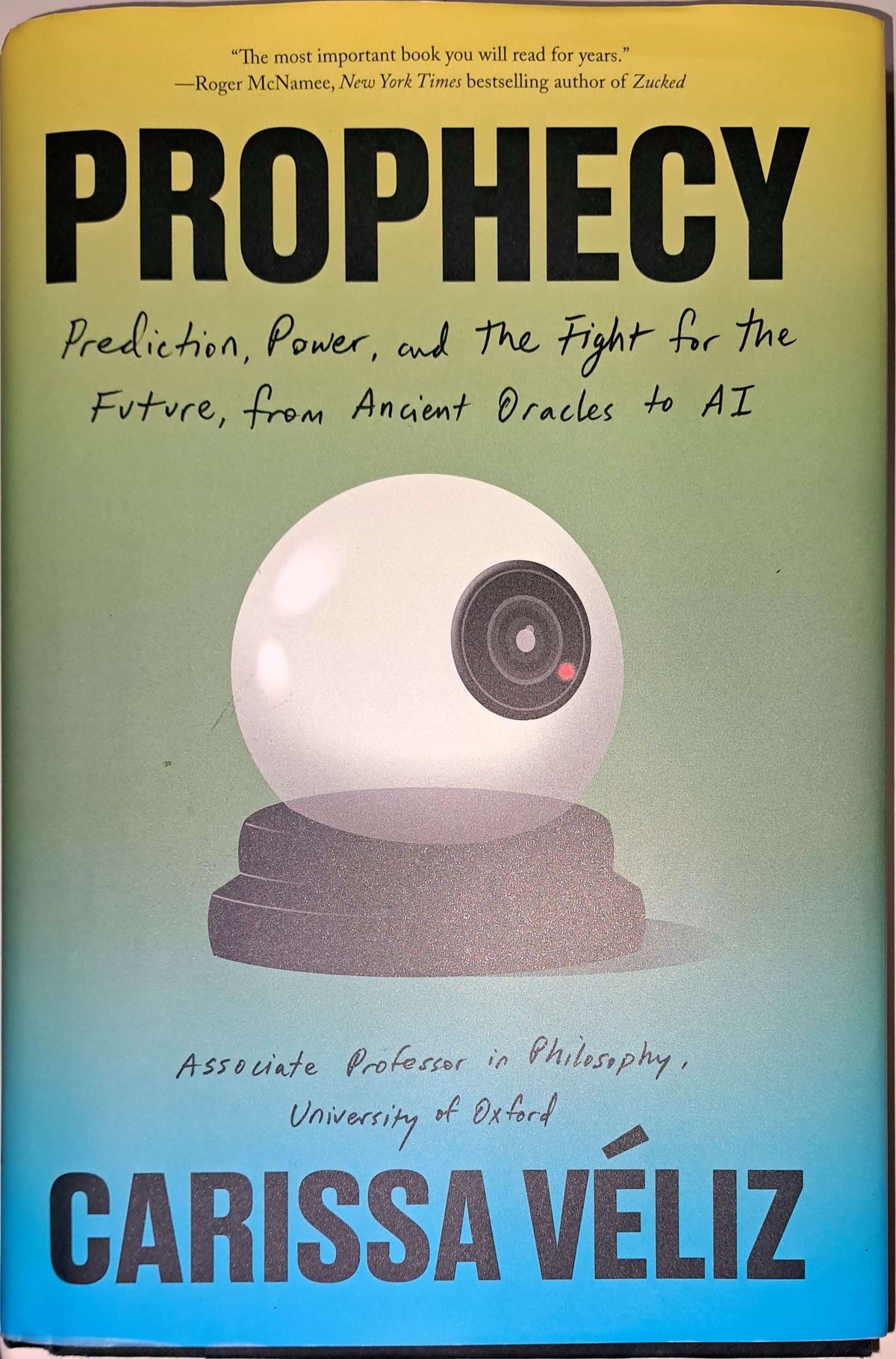
I’ve started and restarted this review of Prophecy by Carissa Véliz for a month and can’t get it right. First, I started with a joke about wanting to write about the moon. Then a story about retelling stories. When neither worked, I wrote about how my father, for years before he died, until he finally predicted right by saying he wouldn’t make it to 70.
Is it better that I started with all of them?
$$$
Okay, I really want to tell you the joke. It goes something like, “I got a degree in how to write about the moon so I wouldn’t have to deal with tech.” It gets mixed responses. I’ve only repeated it once to the same group of people which I categorize as a win.
Each time I tell this joke I think about my father. He was a connoisseur of telling the same story repeatedly. An expert in the art of expected repetition. But, the thing that he always repeated, maybe his favorite prediction, was this ever changing expectation of when he’d die. It was a kind of darkness that inhabited a lot of my father’s humor and worldview.
I found out, from friends of his during his wake, that even when he was a teen, he’d have these predictions about when he would live. “I won’t make it past my 20’s” he’d say. When he did make it past his twenties to have two children in his thirties, he’d say things to my mother like, “I’m not going to make it past 42.” He made it to 66, finally predicting correct-ish.
In a way, I read this joke/prediction/fascination with death as a way for him to control something in a world he had, to be fair, little control over. He was consistently depressed, consistently looking for work, trying his best to be a good person with the limits that the world put on him. So why not predict your death? Eventually, you’ll be right even if you won’t be around to see it.
My father also fulfilled his own smaller predictions in frustrating, complicated ways. The way he dealt with smoking or healthcare or dental care. The ways he would say, “I can’t get groceries” or “I don’t have anything to eat” like he was convincing himself these things were true. Then they would be. My father, in an extremely small way, was absolutely controlled by the beliefs he had in what was possible. It’s the main thing he left me along with a box of never opened Playboy Magazines.
$$$
None of it feels right, I think, because this book is sitting with me in a way that I haven’t yet found a place for. Usually, when I read a book that really changes me deeply I can feel where it sits inside my body. The first time I read Li-Young Lee had its spot in my upper chest, The Parable of the Sower in my hands, Black Skin, White Masks somewhere in my stomach, Pedagogy of the Oppressed in my lower back. But Véliz’s book feels like a weight that it’s still trying to worm its way in. Or, maybe, Prophecy is one the first books I’ve read that really makes me think of connective tissue rather than a section of the body.
$$$
I’m too loose with language here. Prophecy is not a prophecy at all but an attempt at truth. Or maybe fact. Facts that get towards a truth. Truth opened from its can by the half broken can opener of facts.
I hope James Goodman, my creative nonfiction teacher from grad school, felt a little tingle of happiness just then.
Véliz says it like this: “That’s why it matters that we recognize that predictions are not facts; if we treat predictions as facts, if we count them as truths, then we are bound towards injustice and a loss of freedom.” (112)
Truth is freedom. Or so I’ve been told.
$$$
“If there is one lesson you retain from this book”, Véliz argues early on in Prophecy, “let it be this: Predictions are often power moves disguised as quests for knowledge. Even when predictions are sincere, they can create currents of political influence that change the world. They become power moves.” (18)
That’s a damn good way to summarize Véliz’s book. You miss out on the parts about predictive policing and the prophet of Delphi and a reference to Seeing Like a State which is a wonderful book you should also read and a joke about the percentage of how much data is made up and effective altruism and how these predictive machines make society less volatile but more fragile and Seinfeld and how to watch out for prophecies and and and.
Do you see why I can’t focus? There’s so much twisting that it feels like no matter how many times I turn that little piece of metal to keep my bread closed, I can’t make it tight enough. I don’t know how to stop. Sometimes I go until it breaks.
$$$
“The extensive use of machine learning is fueling the illusion of predictability. It’s making society and the economy less volatile but more fragile. Big data can make it seem as if we were on the verge of attaining near omniscience with every extra data point we collect, but no amount of data will help us prepare for the unpredictable, for the times when the future does not resemble the past.” (191-192).
That some good good writing. Can you feel it? The heat rising at the back of your neck? The way that your chest is opening to something you can feel in your heart. Can you feel it? What comes after:
“The extensive use of predictive AI is thus making society less resilient while seeming to make it stronger. By introducing more complexity into the system, and shrouding its fragility, we are making the world more unpredictable. By collecting more data than ever, we have achieved less predictability than ever.” (192)
There is no way to know it all yet pursuit of knowing is the only thing worth staying alive for. The knowing of my child, of other people, of the world, of the trees, of the roads, of myself. Yet I can’t collect this in points on a graph. I can only collect it through metaphor and the vague hope that something I make will help you see me.
$$$
This isn’t all to say I didn’t have some issues with the book. There’s always something, yea?
The end felt like Véliz wasn’t sure how to end it. It felt like the end of The Lord of the Rings movies. You know how there’s like many many endings because, also, the books keep going after the main events too? Felt like that but, like, small potatoes here. I don’t think being compared to LotR is a net negative.
I also didn’t love the comedies and comedians she references. This is nitpicky but I felt there were better examples of comedians to play with here. Also, I kinda wanted to be like, “Have you watched Superstore yet? Can we talk about that in relationship to how you’re discussing comedy?” Maybe I just want to be friends.
The final thing that I remember sticking out to me is that early in the book, around page 55 (though a little bit earlier too), Véliz talks about growing into strangers as we gather in cities, hence we rely on data or quantification more. I won’t argue that I think the track she’s on here is correct but I was really curious how very old cities played into this narrative.
Specifically, I’ve finished reading Four Lost Cities by Annalee Newitz in particular which got me thinking that this idea of moving from a “smaller” community to a “larger” one is a narrative not born out in history. Like, humans have, for an extremely long time, congregated in cities/city-like places. So I do wonder if the history that Véliz outlines, specifically the history of thought that she’s outlining, has a larger hold on the reliance on more quantification rather than the move towards cities generally?
But these problems are more like I’d love to chat and learn more rather than I whole-heartedly disagree. So “problems” not problems?
$$$
In a different universe, a different timeline I think I would have liked to write comedy, maybe do some standup.
For those who don’t know me well this will read as the most straight cis-male coded sentence I’ve ever written. That’s fair. That’s true (again, yes to truth). But I have a love of it, specifically of the ways that comedy can move against the mainstream current. The ways that comedy can be subtle.
In this way I think comedy and poetry are a lot alike. I often, after a beer or two, will go into why I think standup and poetry have a lot in common. Hell, feed me another beer and I might argue that comics, too, fit within this trio of art forms that have some sort of common center: they require effort/interaction from the audience for it to exist.
Prose will walk you through something, lay it out for you. While a comic (the standing one and the juxtaposed one) needs you to do the work. To find where the funny is or what is in between the panels. Poetry asks a similar leap from the reader, to follow metaphor or sound or image or to see multiple things at once.
Algorithms, as Véliz outlines them in Prophecy, do away with this connection between reader and creator in ways that remove pleasure and joy from the act of creation. People who peddle in prophecy, who try to control you, dislike things like comedy and poetry and comics and art generally because the whole point of these things is to connect. Both the comedian and the audience connect.
Which is probably why I never became a comedian and became a teacher instead; I wasn’t sure how to connect with more than thirty people at once. There’s a joke in there about failed comedians becoming teachers but I can’t find it.
$$$
I found Prophecy via social media. That’s one hell of a prophetic act.
$$$
Véliz talks about her grandfather’s death. She talks about it in relationship to how we count and categorize a death. She says:
“As other causes of death became scrutinized and distilled into more specific categories, it became impossible to die of old age because it was no longer an official category. My grandfather died in his bed, in his nineties, his breathing getting slower until it stopped. When the professionals came to collect his body and fill out the forms, they said he had died of a heart attack. His heart had stopped, no doubt—or else we made a terrible mistake—but was that the cause of his death?
“How we count things changes how we think about them. When we say that people die of heart attacks, as opposed to old age, the remedy seems closer at hand. If only we could avoid heart attacks, we could avoid deaths. How we count things shapes our perception.” (54)
And I think that perception is key to the understanding of Prophecy. Or maybe perception is the key to me figuring out what I want to say about the book. Because if prophecy is about controlling someone’s perception, how does a book talking about perception, prophecy, power, do that without effecting a perception?
No. That’s not an important question. Reading is about shifting perception. Just today, I spoke with a student about how we can’t write for everyone. Our audience can be limited. And that, in fact, if we, as readers, are reading something we don’t understand or get or don’t have the cultural connection for, then it’s up to us to figure it out, research it, do the work of understanding. Because, I said to this student, we read to broaden our perception. We WANT to have our experiences, our understanding broadened.
$$$
I think of this book I read many years ago that was about stories. This book, about story and the power of story, was so difficult for me to start getting into because from the beginning of the book, the author could not recognize that he was doing an awful job at telling a story of story.
It’s the constant problem of metacognition; how do I know that I’m reflecting in a way that will help me transfer what I’m reflecting on? Or, more commonly in my day job, if I’m teaching someone about teaching but doing a poor job doing it, should I be teaching about teaching? The author of the book on story should not have been writing about stories if he couldn’t recognize that he was, in fact, telling a story. He’s a story.
Véliz though gets what she’s doing. By writing a book about prophecy, she is pulling the curtains away from something that doesn’t want to be revealed. She is providing her perception on prophecy and its perceptions, yet never pretends otherwise. Who could have predicted the book on prediction potentially predicting how we respond to prediction? Véliz did.
$$$
Another book I thought about often while reading this book was Derecka Purnell’s book Becoming Abolitionists. There isn’t actually a direct connection between these two books other than I think they’re both good but Purnell’s book has a similar strength that Véliz has in Propehcy.
Both books are excellent starting points for people looking to deeply dive into something. To be clear here, neither book are necessarily “introductions” to something like a 101 course on a topic. Instead, both function as places where you go deeper into the caves to discover more. Or, they function as the people who take your hand when you stop watching the shadows on the wall and help lead you towards one of the many exits.
Becoming Abolitionists was a book that I wish I had found before I had really started down the path of learning about prison and police abolition. Similarly, I wish Prophecy existed before I had to be thrown in the fire of algorithmic prediction trying to convince my students it could “help”.
They both also do something rhetorically brilliant too: they try to meet you where you are and explain things in a way that gets you to understand where they come from. Both are full of facts and truth (again, you arrive my ghost) but also of kindness. Understanding. Heart. Which here I want to clarify to say that neither holds back which, to me, is true kindness; telling me when, how, and why I fucked up. That’s genuine care. That’s love.
$$$
It’s uncomfortable to think about Prophecy as love. Uncomfortable because it describes too much that is absolutely not love.
Towards the end of the book, after many descriptions of the ways that prediction pursues power, an antagonist of love at best, she has this long quote about the “new prophets” who are the billionaires controlling prediction currently and, knowingly, destroying so much of the world that many of us value:
“Why would the new prophets engage in such destructive practices if they know they are bringing about havoc? Hannah Arendt argued that only destruction can satisfy the voracity of someone who cannot accumulate more power through wealth. The new prophets are already so rich that earning $10 billion more wouldn’t feel like anything. And yet their lust for power is still there. So what do they do? They start destroying, because ‘the most radical and the only secure form of possession is destruction, for only what we have destroyed is safely and forever ours,’ writes Arendt.” (191)
What a beautiful description of this antithesis of love, destruction. An antithesis so pure that you can see love and destruction making eyes at each other across a bar. You can see them kissing as the lights come up. You can see word balloons above each of their heads saying, “I can fix them.”
Yet I can’t stop thinking about Prophecy as love because what an honor to have a book break something down so intimately. What grace to have someone say, “Have you considered this angle as well?” What humanity to offer up small anecdotes about her grandfather, the comedy she likes, the parties she regrets attending all so that we can better see what is trying to make us less free.
This book is an act of love for the world that Véliz wants to see.
$$$
There’s a part where Véliz describes the current peddlers of prophecy as bullies and holy hell did I laugh out loud reading that part. Every single bully I’ve ever met from coworker to middle school to the ones my kid is navigating now, feels like the same mix of damaged, incurious, egoist as all these billionaires run amok. It’s Mike and Bill and Chris and Anthony and and and.
And yea, letting the air out of them by saying, “No, I won’t” continues to be solid advice.
$$$
At the end, Véliz has ten lessons in prediction. Her second one is really good: Watch Out for Prophecies.
Specifically the part where she says to ask questions. Love that advice. Always up for questions. Because being curious not only keeps life worth living friends, it keeps you a little bit more safe from people trying to use and abuse you. Gotta love that.
$$$
No, I will not use your automated voice machine to order my drive thru.
No, I will not let it go when you’re using AI to make your poster.
No, I won’t dehumanize you by pretending that you didn’t use it to write your paper, draw your picture, make your gif, make your sticker, whatever.
I refuse your future.
No, I will not let it come to pass.
No, I will not lay down while you destroy my child’s future and mine.
No, I will not stop creating and playing and loving and caring and being human just because you don’t want to anymore. You can always walk into the ocean and never return. Choose the ocean.
$$$
I don’t know if this is a good review or one that even makes sense. I’m distracted and disconnected and overwhelmed, it feels like on purpose. But this book helped me see a little clearer in the shakiness that is my life.
Prophecy is worth the read because it is genuinely hopeful. It pursues knowledge and truth (see, you thought I forgot you but I didn’t) in ways that are genuine. Véliz goes all in on her ideas, really trying to make sense of everything laid out before her. It’s a book that I hope many people will find and rediscover and dig into as the people with the purse strings continue to try to control us. And I hope we’ll continue to say no. Then read another book.
Thank you so much for reading! If you'd like to help me be less confused about what I'm reading and why, please subscribe or convince a friend to! It will always be free but there is an option for a monthly subscription if you can.
If you liked this review particularly, please leave a tip below so that I tell my kid I made money from my writing.
 About the Author