Some Poetry Books (That I’ve Read) Half Way Through 2026
Even as I write that title, it is July so I know that this is not getting out at the beginning of July/end of June as I planned (no I will not tell you when I’m writing it [it’s before July 15{it’s July 14th}]). Regardless, it is here now.
My idea for this post came from seeing some lists of suggested books for summer reading and not seeing poetry be part of that conversation. I think that part of this is where I get my info and suggestions, of course, but part of it is also that poetry is not something that is suggested to people who don’t typically read a lot of poetry. Which I think is a loss.
Now, I don’t want to get into the reasons why people don’t read poetry or don’t talk about it, mainly because we’ll be here all night and neither of us have the time. So whether it be that poetry is challenging/important and therefore doesn’t get financial support or it’s the move towards poets being stuck in academia or it’s how poetry is taught to us in middle and high school, the reality remains that poetry books aren’t talked about in many of these lists and can be a daunting thing to start getting into.
For me, I’ve come to see this conversation as similar to those who are curious about comics but don’t know where to start. “How many issues of Batman before the story I want to read?” That kinda thing. So, I decided to frame this short set of reviews/summaries for the readers who may not have read poetry recently or who haven’t ever approached a poetry book before. I’m taking a bit of a, “okay so what might you need to know to get into it” kinda thing. I was also reminded by a friend about how I used to drop into people’s offices and talk about books I’ve read (I still do this and it is a joke that is making it into an article at my job which I guess makes this habit of mine famous) so I wanted it to feel a bit like that too.
If any of these peak your interest, I strongly suggest going to your local indie bookseller (or use Bookshop.org or your favorite used book site!) or your library to pick up a copy. The library is a great choice here, especially for those who may not be that into poetry because if you don’t like it? You get to return it and try again!
Side note: libraries rule.
Oh! These could also be great choices if you want to participate in the Sealey Challenge this August. I’ll link it here, but basically it’s a challenge to read a poetry book a day in the month of August which, honestly, I have never even come close to doing. But I know plenty of people who read a poem a day or a book a week or some variation of that. It’s a fun yearly event for sure.
But as a final note before getting into the convos about the books, I really want to encourage you all to read more poems. They move you different than prose does and stretch your brain in different ways. You know how after you work out you feel a little sore because you haven’t moved that part of your body in a long ass time? It’s like that. But with lines and metaphor. And in your brain. It might be uncomfortable at first or new feeling, but in a good way. Listen we all had to try boba for the first time and now we’re obsessed. Just me? Okay. Fine.
As a little treat, I’ve copied a poem from each book and included it here as well. Where I host Widely Read doesn’t actually have much character length for alt text, so after each poem I’ll have a typed out version of it as well. Feel free to skip this if you don’t use alt text or read whichever version of the poem feels good to you! It’s a little practice in reading poems. Like stretching bef…okay okay I’m beating a dead enjambment with an action verb. I will move forward to books!
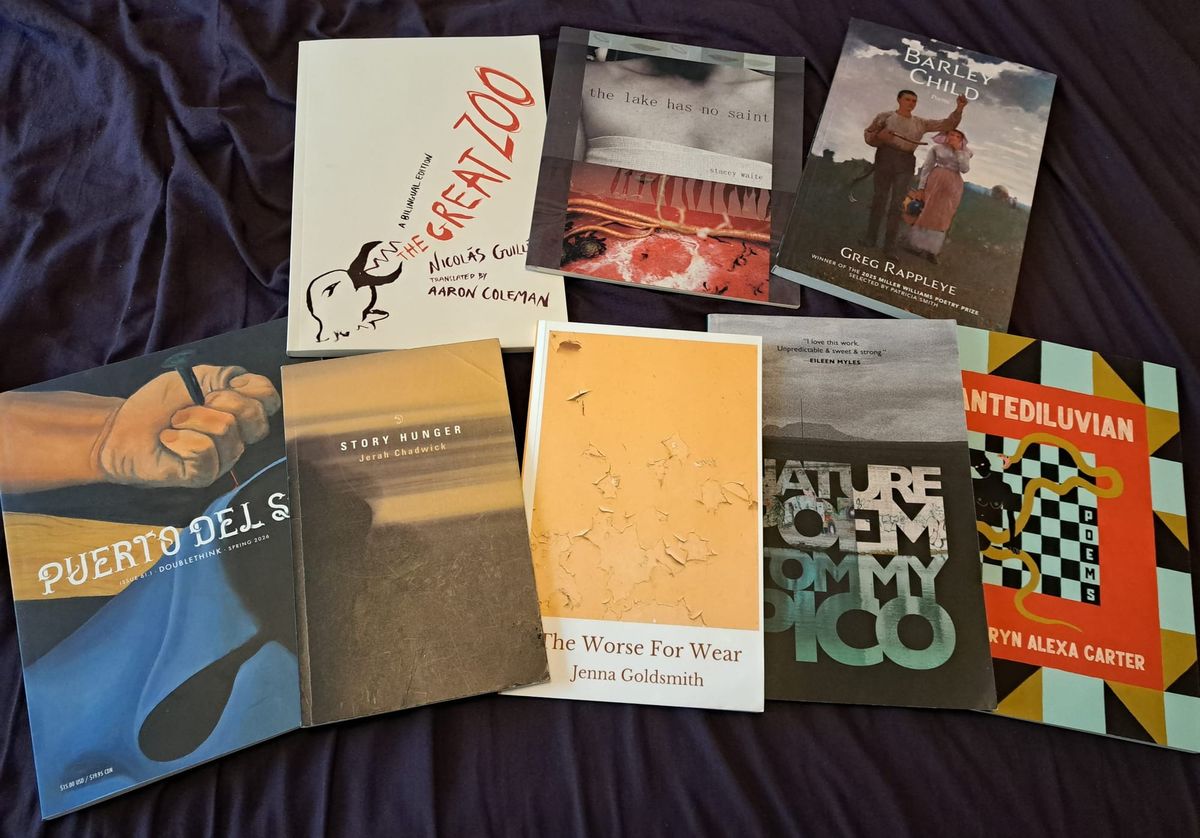
Puerto del Sol Issue 61.1: Doublethink
Okay, so we’re starting off with the only journal in the lot because I literally put all the books in a bag and randomly pulled one out. Full disclosure, I read this journal because a poem of mine appears in it, so I’ll share that at the end for more poetry goodness. I’m ignoring my poem for this brief review. Here we go!
I’ve enjoyed dipping into Puerto del Sol for a while now. I think I was first introduced to it in grad school? Though it might have been shortly afterwards. I went on a journey through their back catalogue to see if I could visually remember which physical issue I read from way back, but I couldn’t figure it out. I tried.
Each of their issues are a mix of poetry, creative nonfiction, and fiction which might be a nice way to get back into the swing of things AND to see some of what newer writers are creating. Fair warning that not all are clearly fiction/CNF and poetry always plays with those boundaries, so just vibe with it. It’ll treat you well.
While much of the fiction and nonfiction was splendid, the poetry was no slouch either. The journal is broken in half with a new title page halfway through so I assume that the first half is focused on the idea of “doublethink” from the title while the second half is more general, but still, I felt like there was a thread of “fact and idea fused together” to quote from their short description throughout.
There were poems about miscommunication and tree stumps being lit on fire, Song of Songs references and sleepwalking. I mean, if you need variety it’s here.
I think that journals/magazines are really slept on as some of the best ways to start dipping your toes into the poetry sphere. There’s no better place to find out what you like and what you don’t, what moves you and what makes you go meh, and what sticks with you far after you’re done reading the issue. Puerto del Sol is a big one coming in at 200 pages, but most are really tiny. You can get them done in a week or less, and it feels like you’ve really tried a lot of different things.
Extra bonus, it’s always fun to see which authors you end up loving then go see if they have books out already. Solid way to get deeper into the reading.
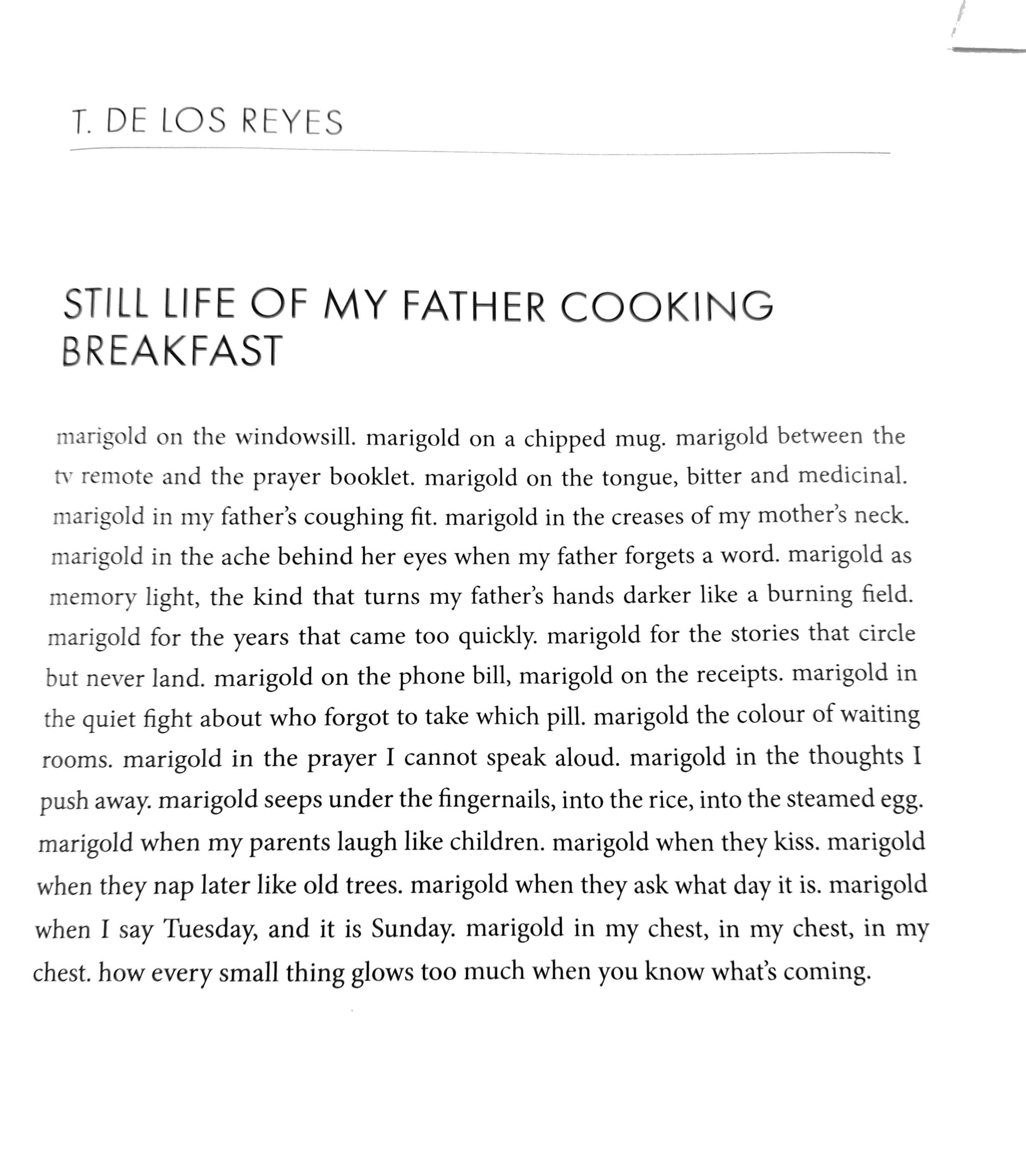
Alt-text of poem:
Still Life of My Father Cooking Breakfast
marigold on the windowsill. marigold on a chipped mug. marigold between the tv remote and the prayer booklet. marigold on the tongue, bitter and medicinal. marigold in my father's coughing fit. marigold in the creases of my mother's neck. marigold in the ache behind her eyes when my father forgets a word. marigold as memory light, the kind that turns my father's hands darker like a burning field. marigold for the years that came too quickly. marigold for the stories that circle but never land. marigold on the phone bill, marigold on the receipts. marigold in the quiet fight about who forgot to take which pill. marigold the colour of waiting rooms. marigold in the prayer I cannot speak aloud. marigold in the thoughts I push away. marigold seeps under the fingernails, into the rice, into the steamed egg. marigold when my parents laugh like children. marigold when they kiss. marigold when they nap later like old trees. marigold when they ask what day it is. marigold when I say Tuesday, and it is Sunday. marigold in my chest, in my chest. how every small thing glows too much when you know what's coming.
the lake has no saint by Stacey Waite
This is a short poetry chapbook that tackles gender, intimacy, not fitting in, growing up, a little grief, a little heartbreak, a little love, some trees; honestly it’s all I want in a poetry book.
If you’re not familiar with the term “chapbook”, it’s all good. Think “really short book” like “novella” and you’ve got a good idea. There are lots of publishers that publish these and they often have pretty tight themes/styles, so a great place to start exploring once you, obviously, become obsessed with poetry.
This chapbook is mostly in prose poetry, or prose-ish poetry, with some poems broken into lines between. Lots of short and to the point poems, ones that focus on a small thing and explode it to be about basically everything. There are lots of brilliant moments in here where Waite plays with the moment of going to the bathroom as a little kid or their father’s dialysis nurse.
There’s beautiful lines that surround some really profound introspection around what it is to present gender, what it is to love another human, what it is to live up to expectations, or not. I found these poems to the point and expansive. Even though it’s a short book, there’s a world of different things going on in it.
I strongly suggest picking this up if you have some familiarity with poetry or have been away for a long time. It being short, and many of the poems being short, it feels quick though many of them will make you slow down in the best way possible. It’s also great for those of you missing the joys of Pride month or who want to read about the fluidness of gender.
I think this was the first physical book I finished reading this year, so it was a hell of a good start to my reading year.
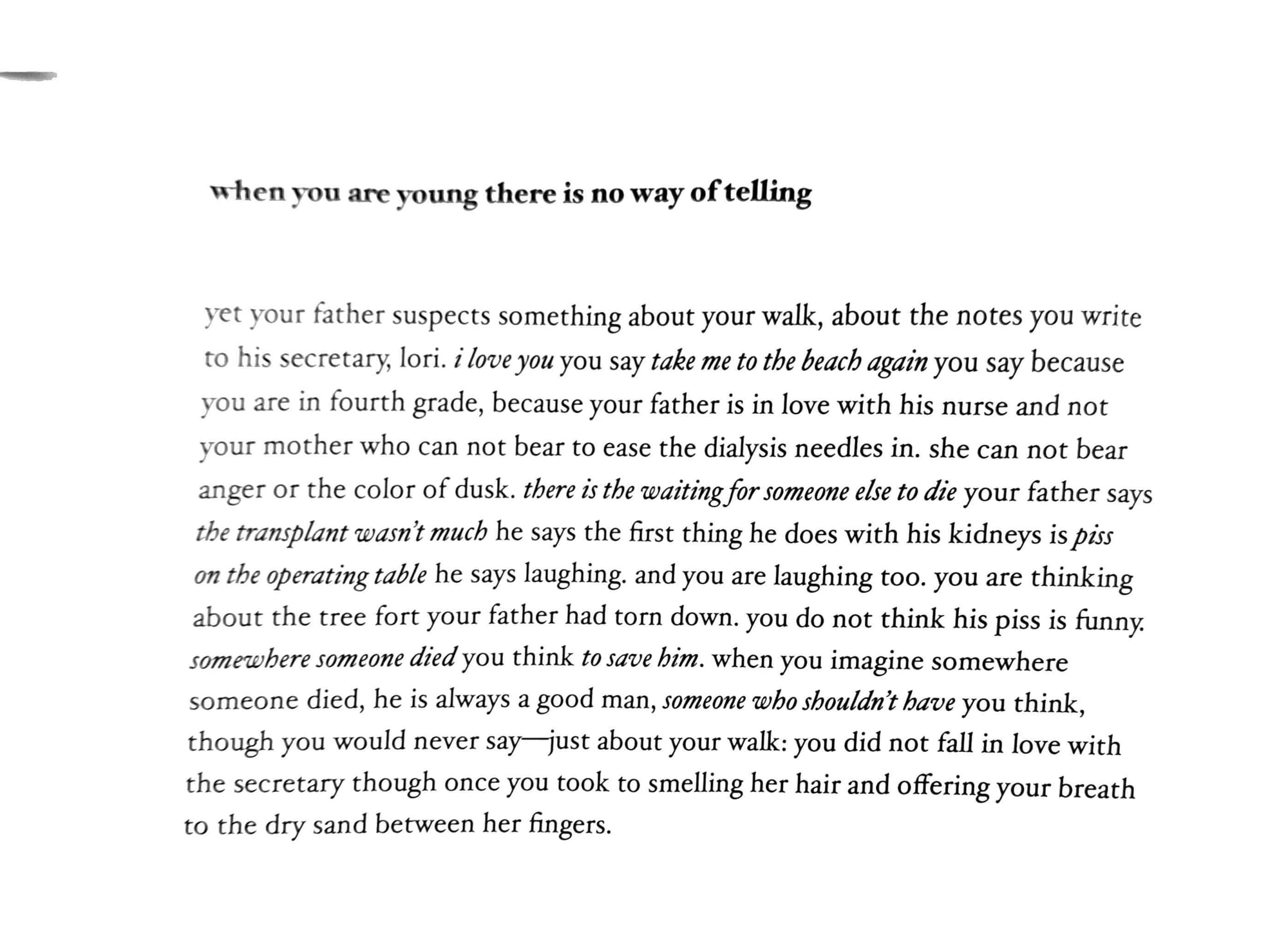
Alt-text of poem:
when you are young there is no way of telling
yet your father suspects something about your walk, about the notes you write to his secretary, lori. i love you you say take me to the beach again you say because you are in fourth grade, because your father is in love with his nurse and not your mother who can not bear to ease the dialysis needles in. she can not bear anger or the color of dusk. there is the waiting for someone else to die your father says the transplant wasn't much he says the first thing he does with his kidneys is piss on the operating table he says laughing. and you are laughing too. you are thinking about the tree fort your father had torn down. you do not think his piss is funny. somewhere someone died you think to save him. when you imagine somewhere someone died, he is always a good man, someone who shouldn't have you think, though you would never say – just about your walk: you did not fall in love with the secretary though once you took to smelling her hair and offering your breath to dry sand between her fingers.
The Great Zoo by Nicolás Guillén translated by Aaron Coleman
This book came to me as a surprise. I got to see Coleman read some of his poems and some of these translated poems which made me super interested in Coleman’s work as a translator and poet, as well as in Guillén’s work too.
(Note: If there is an opportunity for you to go to a poetry reading near you, I strongly suggest. It’s a really beautiful experience hearing poetry read out loud and I think it’s a great way to see what’s out there, especially if there’s local poets! Typically your library or a local university/college will have something on the books during the Fall, Winter, and Spring months coming up. If you’re blessed with an indie bookstore, check out there too!)
The idea of a poetry book that takes you through a “great zoo” where what is displayed is sometimes beetles, sometimes a guitar, sometimes the KKK or police, and sometimes a dream, is a wild good time for me. The book I read is a bilingual edition, so there’s the Spanish version and the English version of each poem. Though I don’t read Spanish, I do really love having this and getting to see what I do recognize and how Coleman decided to translate the ideas from the poem.
The poems themselves are pretty direct and very much feel in the mode of odes or poetic descriptions. It feels like these are the little plaques that you get to read about the animals in the zoo but with more metaphor and meaning. Or, it feels like Guillén is taking you on a tour of the zoo, describing little histories and little memories of each thing that you see. The book seems to imagine that you’re being shown something only for the tour guide to illuminate it further with a little hand flourish.
Honestly, I think this book is an extremely accessible poetry book even if you mainly read prose. There might be some moves that feel extremely “poetic” in a way that you don’t know how to explain exactly. But remember that this isn’t a test. You can enjoy the poem even without knowing exactly what the vehicle of the metaphor is. Also, many of the poems here are quite clever and funny. Coleman does an excellent job here making that translate well into contemporary English.
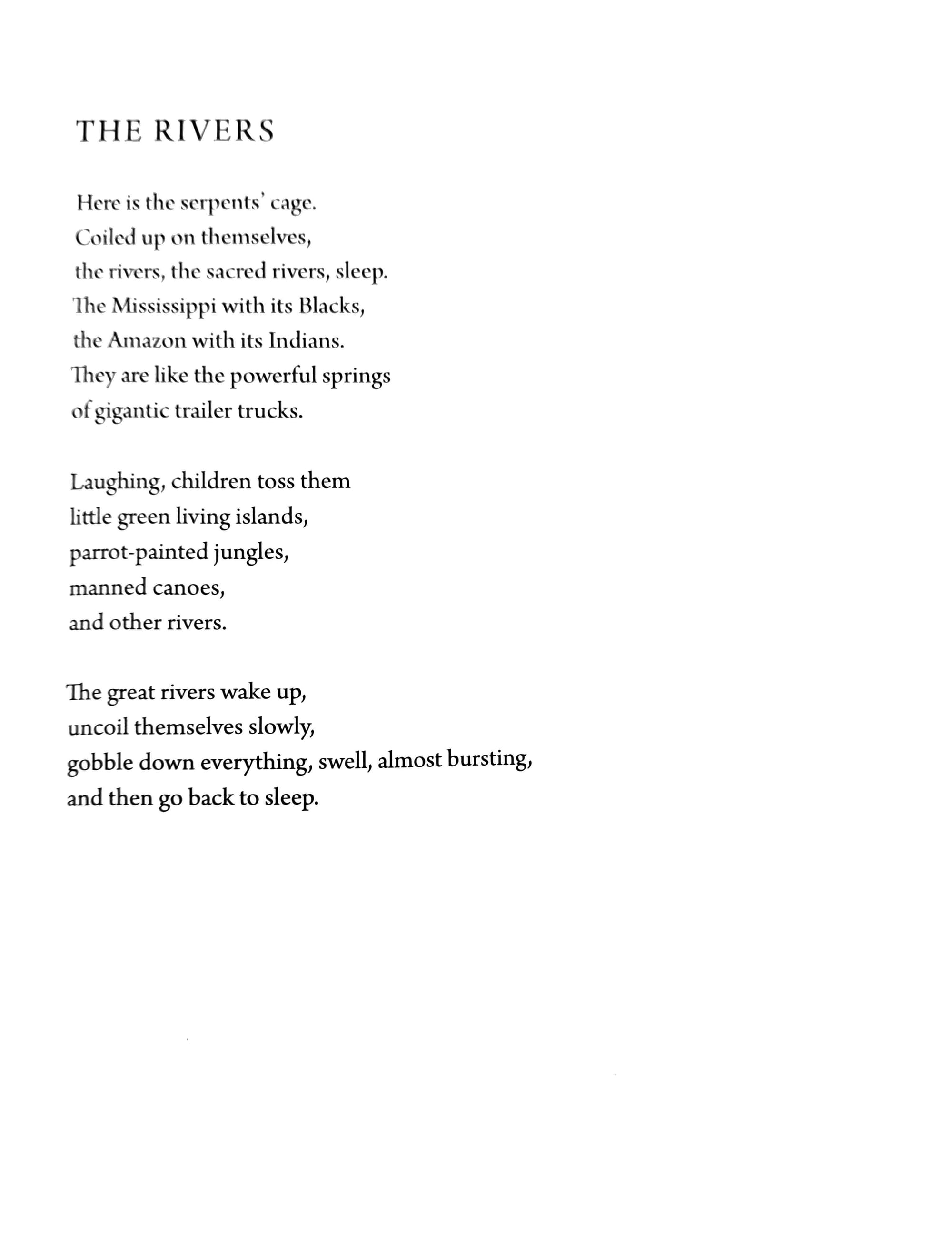
Alt-text of poem:
The Rivers
Here is the serpents' cage.
Coiled up on themselves,
the rivers, the sacred rivers, sleep.
The Mississippi with its Blacks,
the Amazon with its Indians.
They are like the powerful springs
of gigantic trailer trucks.
Laughing, children toss them
little green living islands,
parrot-painted jungles,
manned canoes,
and other rivers.
The great rivers wake up,
uncoil themselves slowly,
gobble down everything, swell, almost bursting,
and then go back to sleep.
Story Hunger by Jerah Chadwick
I have a book buying “problem” that I don’t really define as a problem so much as a space issue. I live in a small apartment, you see, and I can’t keep stacking my books in the pantry. So, I’ve really put the brakes on buying new books because, as with Chadwick’s poetry book, I buy them and then don’t get to reading them until much later.
I think that I bought Story Hunger a couple years ago on a vacation which for me is basically going to comic book shops and bookstores. I bought it because I hadn’t heard of it before and I’m a big fan of poets from different places or experiences or backgrounds than me because I like how this common form of writing explodes out in similar yet unique ways no matter where you are. Specifically, I thought it was fascinating that Chadwick lived on the Aleutian Island of Unalaska which I didn’t even know about until looking it up after reading the book.
The book itself was very grounded in that place and in Ireland. I couldn’t exactly figure out if that was because of Chadwick’s family background or if, like Unalaska, it was a place he visited/lived in, but they both figure prominently in the book. Usually, I’m a bit mixed about poems that are grounded in a specific place. For me, it can feel like I can’t connect, but when it works, it works because it makes me feel like I’ve learned something new or found out a piece of history that I didn’t expect to. This is very much how it felt reading this book.
The poems here give you insight into one person’s view of a set of places, the stories he’s heard, the things he knows already. It really does create a whole image of a place while taking historical moments that seem to reach into the present through these poems. Some of the poems even have notes that give a little more context for the historical events that were written about, which is an added bonus. Though Chadwick is clearly not a native resident of this place, he is still approaching everything with grace as far as I could tell. It didn’t lean into common tropes of “white man goes to new place” which can also be the case in narratives or poems like this.
Unlike straight nonfiction or histories or memoirs, poems add this other layer to the experience of history or an experience of a place. While prose can do this and I’ve read prose that does, poetry adds a layer of the personal that can truly open up the experience of learning about Unalaska, in this instance. It reminds me of visiting a close friend where they live and getting to see what they, specifically, love and care for in that area. Poetry does that pretty explicitly.
This book is accessible to people who don’t read poetry but you may have to slow down a bit if it’s been a minute. The poems are clear and direct, again clearly about people and places, but there are some really beautiful linguistic moves being made here that may take a minute to reread. Really a surprise hit for me!
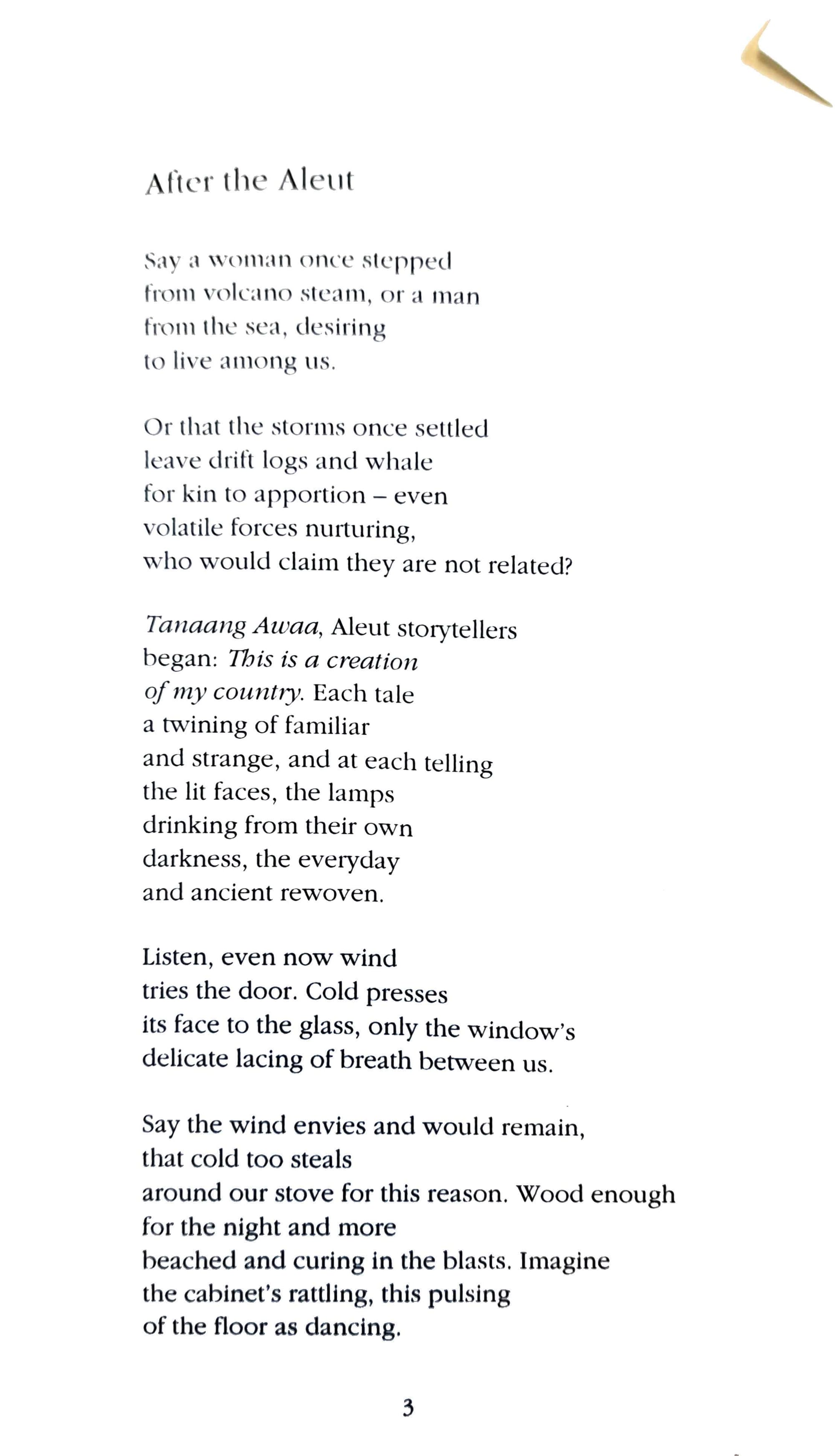
Alt-text for poem:
After the Aleut
Say a woman once stepped
from volcano steam, or a man
from the sea, desiring
to live among us.
Or that the storms once settled
leave drift logs and whale
for kin to apportion – even
volatile forces nurturing,
who would claim they are not related?
Tanaang Awaa, Aleut storytellers
began: This is a creation
of my country. Each tale
a twining of familiar
and strange, and at each telling
the lit faces, the lamps
drinking from their own
darkness, the everyday
and ancient rewoven.
Listen, even now wind
tries the door. Cold presses
its face to the glass, only the window's
delicate lacing of breath between us.
Say the wind envies and would remain,
that cold too steals
around our stove for this reason. Wood enough
for the night and more
beached and curing in the blasts. Imagine
the cabinet's rattling, this pulsing
of the floor as dancing.
The Worse for Wear by Jenna Goldsmith
This poetry collection was another where I saw Goldsmith read her poems and bought the book at the reading. Gosh do I love doing that. (see above for suggestions on going to readings!)
The poetry book itself is very queer and very cool in the variety of poems that you’ll find here. This book is one where if you have a poetry background, you’ll get some good references (to specific poets or forms or when the poems/speakers are addressing/talking about poems) throughout the book. But, even if you’re not into poetry, the variety of ways in which Goldsmith plays with language is impressive and absolutely wonderful to read.
There are poems that are erasures, a poem mainly in a footnote, various forms of repetition, and one that is in the form of a letter from a university president talking about sexual assault on campus. The variety here is stunning while each of these poems also tackle issues around relationships or teaching or work or just living in a body and grieving.
Goldsmith’s book is one where you can really see some of the things that poetry can experiment with or play with. This is another one where I think that picking this book up is a good idea. Let the poems tickle your frontal lobe a little bit and enjoy the ways in which Goldsmith really excels in showing off her ability to use the shape and form of the poem to create a richer experience of the poem itself.
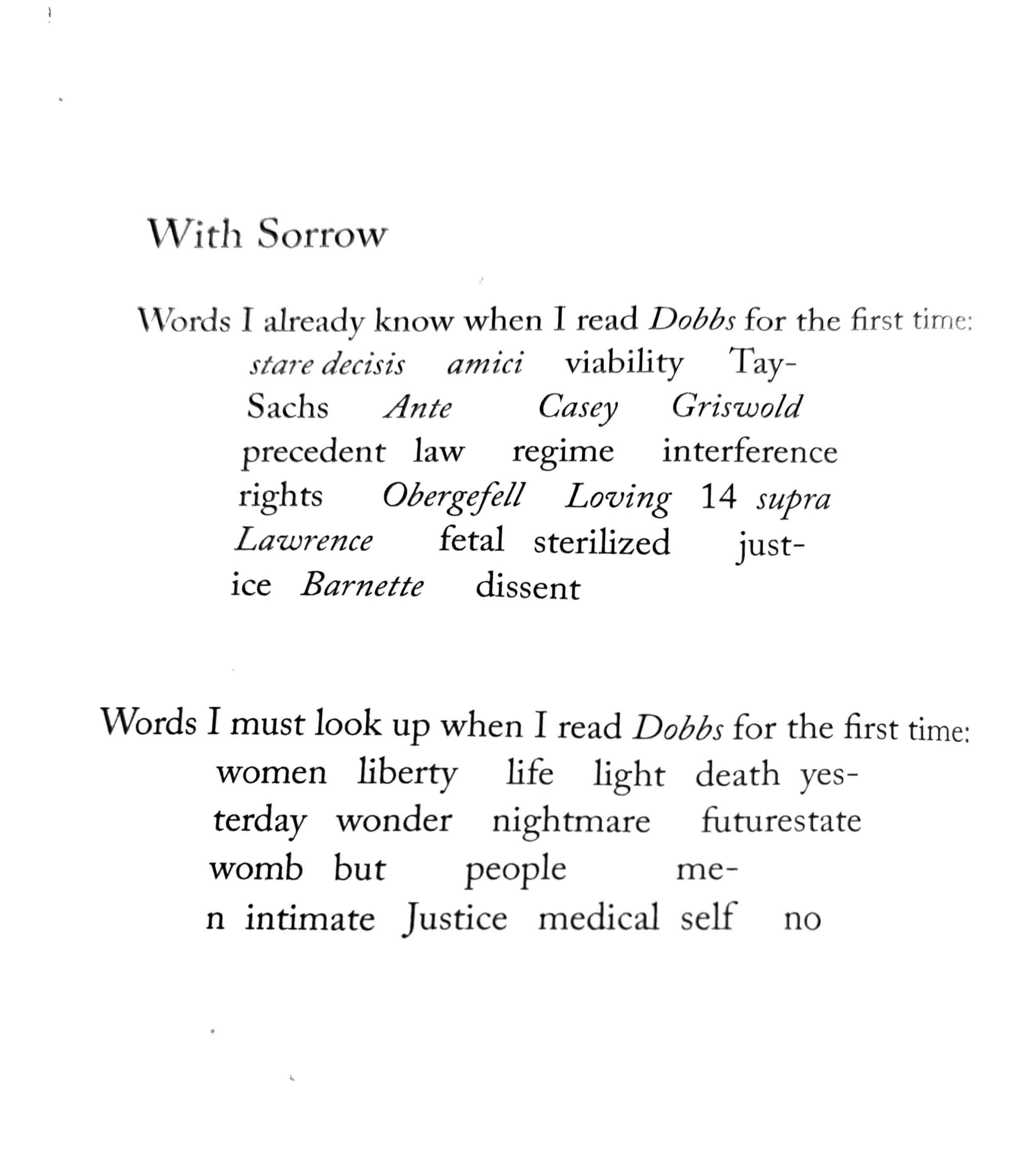
Alt-text of poem (after each line that begins with the word "Words", the following line is visually represented as a box underneath that first line. So the poem reads as a line, then box, then space, then line, then box.):
With Sorrow
Words I already know when I read Dobbs for the first time:
stare decisis amici viability Tay-Sachs Ante Casey Griswold precedent law regime interference rights Obergefell Loving 14 supra Lawrence fetal sterilized just-ice Barnette dissent
Words I must look up when I read Dobbs for the first time:
women liberty life light death yes-terday wonder nightmare futurestate womb but people me-n intimate Justice medical self no
Nature Poem by Tommy Pico
If you’re a reader who’s a fan of series, then this poetry book might be right up your alley. This book by Tommy Pico is part of a series of poetry books that follow the same speaker/narrator through multiple books. Now, I think this one is the first in a three part series but after a quick looky-loo on the interwebs, it does seem like there was a book before it though maybe that one isn’t directly connected to the other three? Regardless, if you like books that have a character that you follow throughout multiple books this is one for you!
This book is from the point of view of a self-described “NDN” (Indigenous American) named Teebs as he talks about nature, how he doesn’t want to write about it, what he describes as his nature/his world around him, and his personal life. The book, itself, is written as though someone is speaking to you, with slang and shortened forms of words throughout the poems. The way that Pico uses this throughout makes the poems have a very consistent and specific voice that’s speaking throughout, which is another thing that may help people coming from prose.
Each poem, as well, flows into the next rather than having different titles. So this book reads as one long, book length poem though there are clear divisions between what I consider to be individual poems. This doesn’t mean that there’s a traditional plot here, but the voice and speaker of each poem stays consistent, so even if the poems jump in time or don’t adhere to what is typically called a plot, there is a clear conversation that emerges from it that is well worth your time.
There are poems here about racism, sex, language, queerness, dating, and of course nature and poetry. I do feel like people who read a lot of poetry will see a lot of what Pico is playing with here and how he’s moving in and out of expectations for what poetry is or does or is expected to do. But, this book is incredibly accessible to those who read no poetry at all because of the language it uses and the directions it takes.
Pico is also one hell of a screenwriter, he wrote for both Resident Alien and Reservation Dogs, so I feel like his control of voice or dialogue here is super effective while also being an in-road for many. This book is one hell of a strong collection of poems (or one hell of a strong poem). Do yourself a favor and dig in.
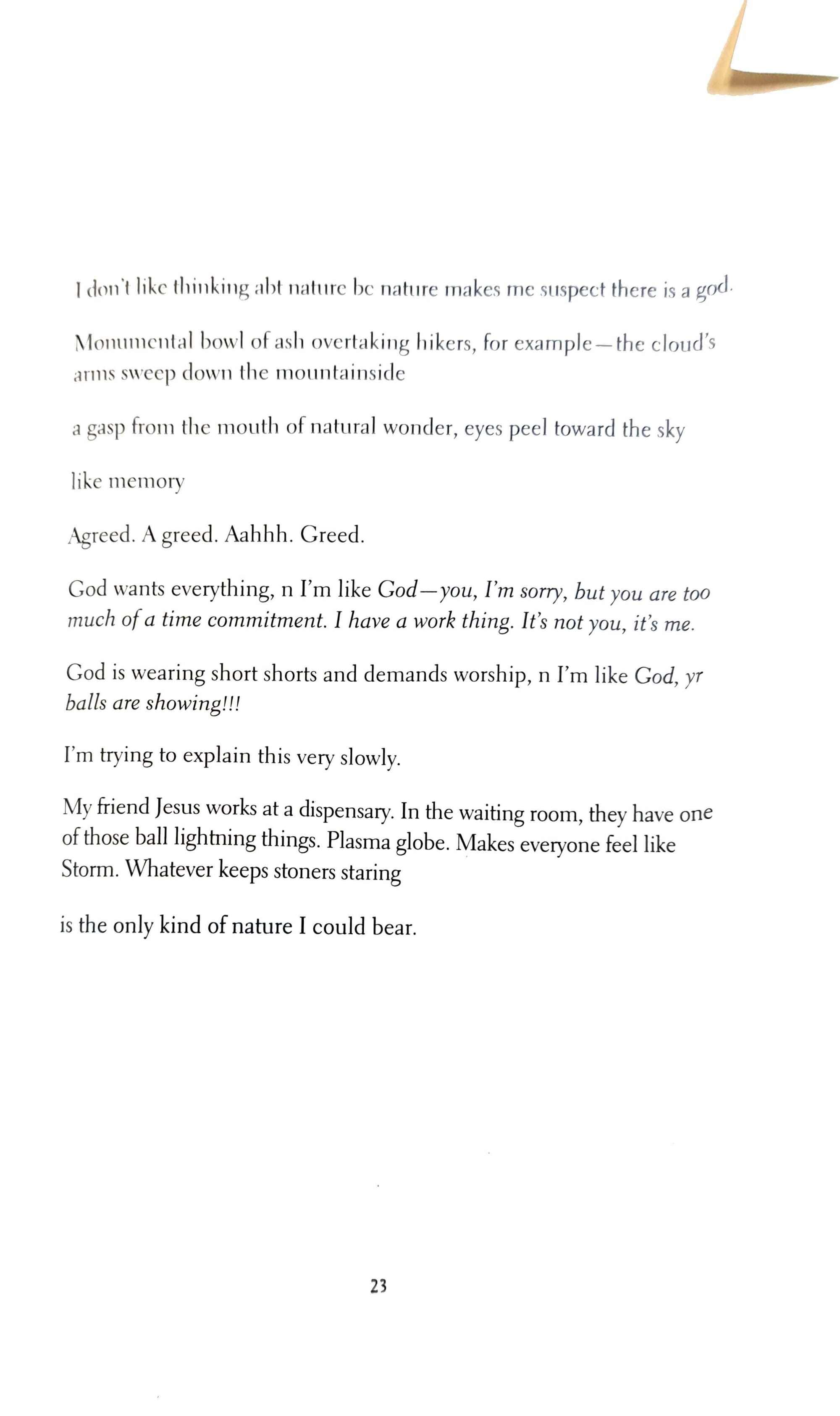
Alt-text for poem:
I don't like thinking abt nature bc nature makes me suspect there is a god.
Monumental bowl of ash overtaking hikers, for example – the cloud's arms sweep down the mountainside
a gasp from the mouth of natural wonder, eyes peel toward the sky
like memory
Agreed. A greed. Aahhh. Greed.
God wants everything, n I'm like God – you, I'm sorry but you are too much of a time commitment. I have a work thing. It's not you, it's me.
God is wearing short shorts and demands worship, n I'm like God, yr balls are showing!!!
I'm trying to explain this very slowly.
My friend Jesus works at a dispensary. In the waiting room, they have one of those ball lightning things. Plasma globe. Makes everyone feel like Storm. Whatever keeps stoners staring
is the only kind of nature I could bear.
Antediluvian by Kameryn Alexa Carter
I love getting poetry books as gifts. Even though I own a ton of poetry books, it always seems like someone gets me one I’ve never heard of before. That’s the case with this book for sure!
This book revolves around mental and physical illness a lot, with the speakers of the poems struggling with anxiety, depression, agoraphobia, and the health effects that go with it. The poems are also pulling from a large variety of sources to make meaning; the Bible, scientific argument, black writers of the past, and myth.
Carter is also an absolute stunner when it comes to sound. The book is full of language that when read together makes your insides move. Sometimes this is hypnotic and other times it’s revelatory, but it’s always super fascinating to see how she’s using sound to help construct meaning or connect ideas together. This is one of the most wonderful and fascinating things in the book, but could be something that holds some people back from getting more into it.
I think that if you’re reading a lot of poetry already, this book will fit within things that you’ve experienced already. It will definitely play with sound in interesting ways and the whole book tackles things that I don’t see often in poetry either, which is super amazing. If you’re not into poetry as much, this book might be one that you struggle with more. I say this and am then reminded of teaching students who are not that into poetry who connect with poems that use sound particularly well. So, who knows? Here, I think that because I took away things related to writing poetry, I’m a little bit skewed towards seeing it in this specific way.
I think that approaching this book as a book that lies very firmly in poetic tradition is a good way to go about it. But, if you can follow a rock, rap, metal, or folk music album, understanding what they’re saying and what the music is doing to help along the meaning of the lyrics, then I think you can do the same here too. Poetry and music aren’t that far apart historically. The poems here are truly wonderful and tackling mental health as Carter does is something that should be celebrated.
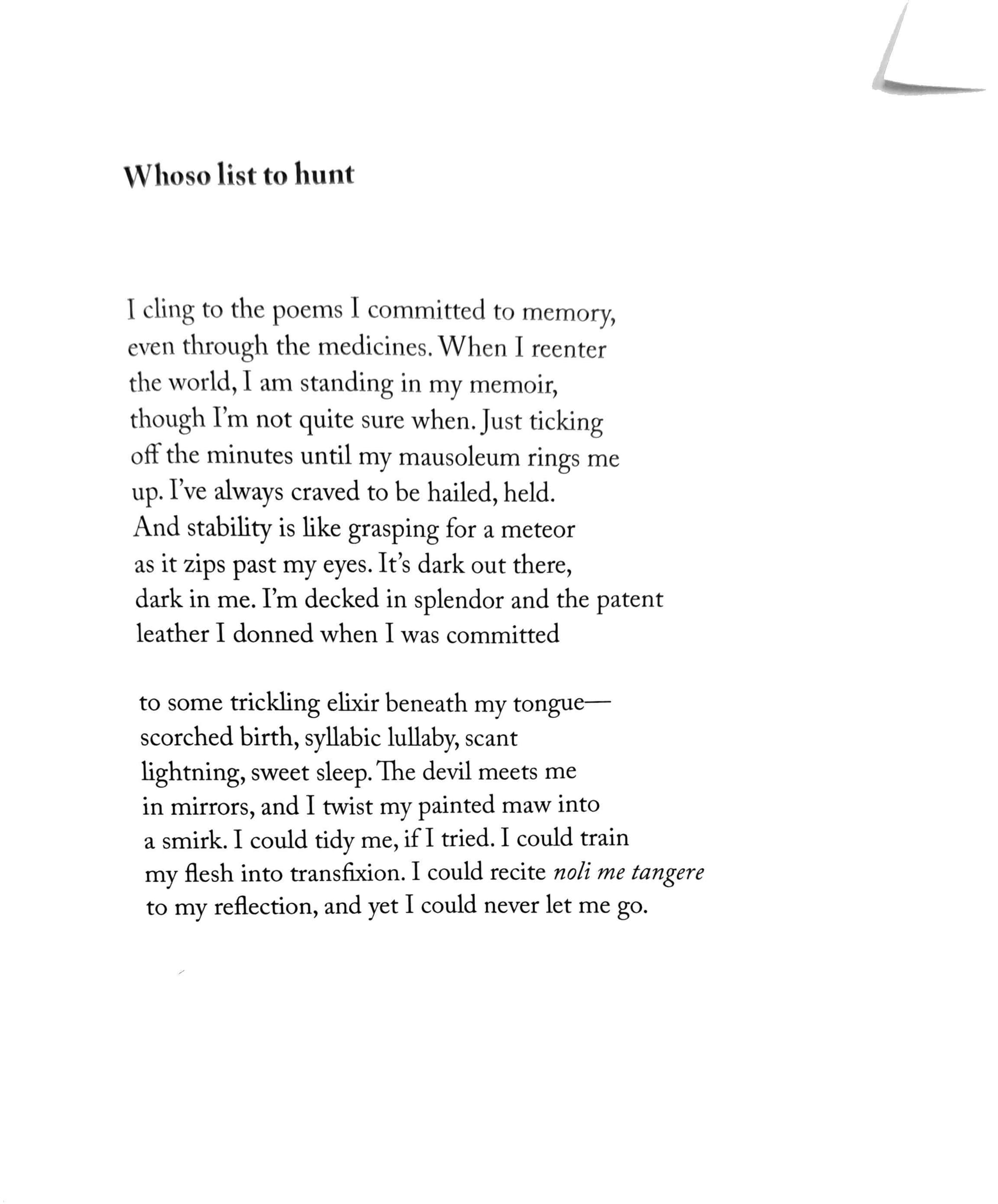
Alt-text for poem:
Whoso list to hunt
I cling to the poems I committed to memory,
even through the medicines. When I reenter
the world, I am standing in my memoir,
though I'm not quite sure when. Just ticking
off the minutes until my mausoleum rings me
up. I've always craved to be hailed, held.
And stability is like grasping for a meteor
as it zips past my eyes. It's dark out there,
dark in me. I'm decked in splendor and the patent
leather I donned when I was committed
to some trickling elixir beneath my tongue--
scorched birth, syllabic lullaby, scant
lightning, sweet sleep. The devil meets me
in mirrors, and I twist my painted maw into
a smirk. I could tidy me, if I tried. I could train
my flesh into transfixion. I could recite noli me tangere
to my reflection, and yet I could never let me go.
Barley Child by Greg Rappleye
Last but not least is this book by Rappleye which recently won the Miller Williams Poetry Prize. The book is very much a large collection of poems that spans the poet’s family history, taking from a rich and complicated set of lives to create many of the poems within.
Similar to what I said above about Story Hunger, this book really delves into one specific space and really digs around to reveal things about it. The space that Rappleye digs into is his family and the ways that that history is connected to things that are happening in the world around them. Deeply rooted in Irish heritage as well, these poems do, at times, feel like little stories that jump around in time and place, but all connect to create a much larger, clearer picture.
These poems are a bit longer and the book is longer too, which fits with what is happening within each. Going from a family member who maybe started a fire to memories of his own childhood to interactions his mother had in and out of a mental hospital, these poems seem to really give a deep dive into what makes someone who they are.
The poems here are also very much interested in sound in ways that may remind you of the poems you had to read in school. But, they don’t actually feel dated or like they’re there to be analyzed. There’s lots in the book that’s complicated and interesting, but it’s a journey that readers of prose are not unfamiliar with; looking into the past to understand the self.
It was a good book and one where jumping around to poems out of order would be fun. Flip through and read a random poem whose title you like is a heck of a fun way to spend a summer day.
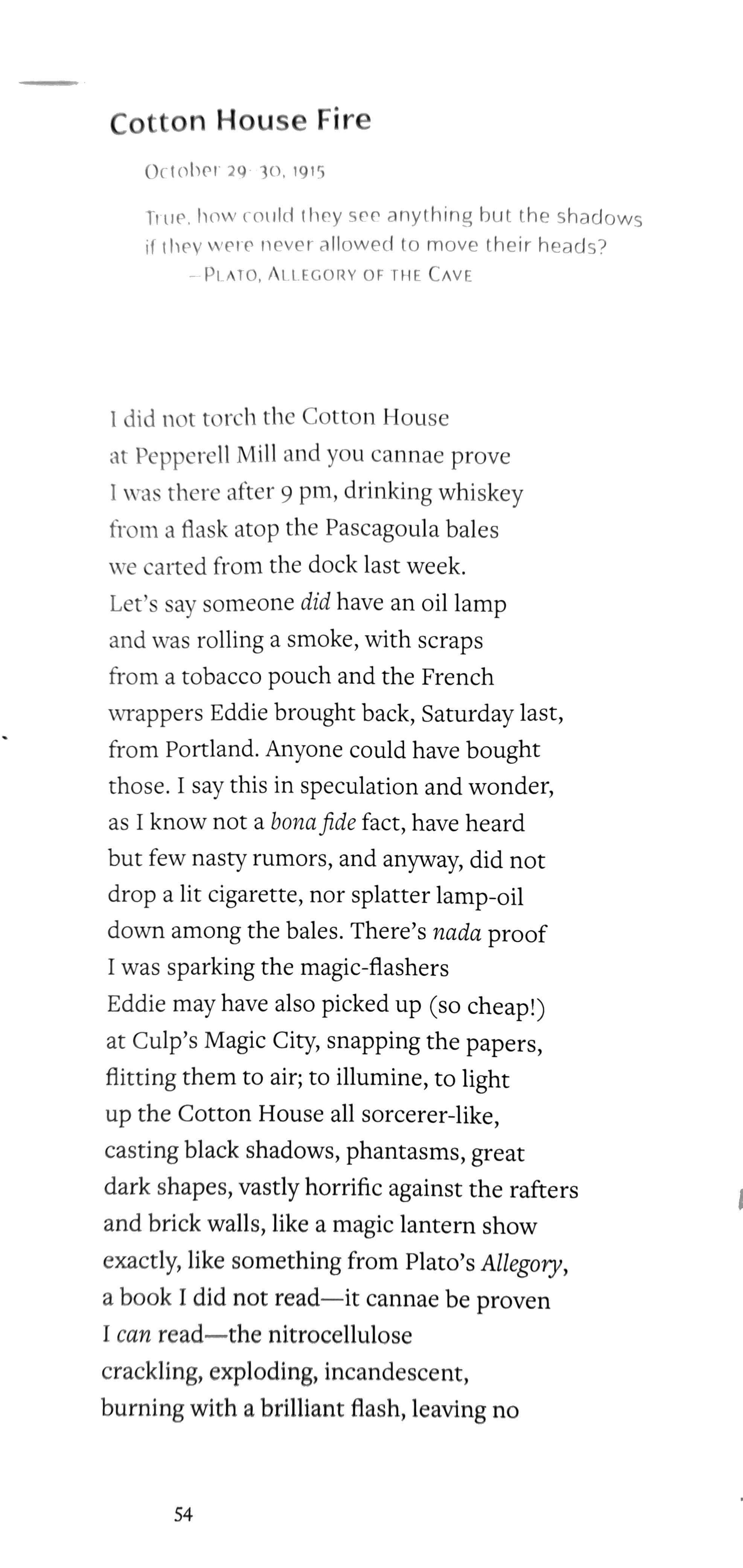
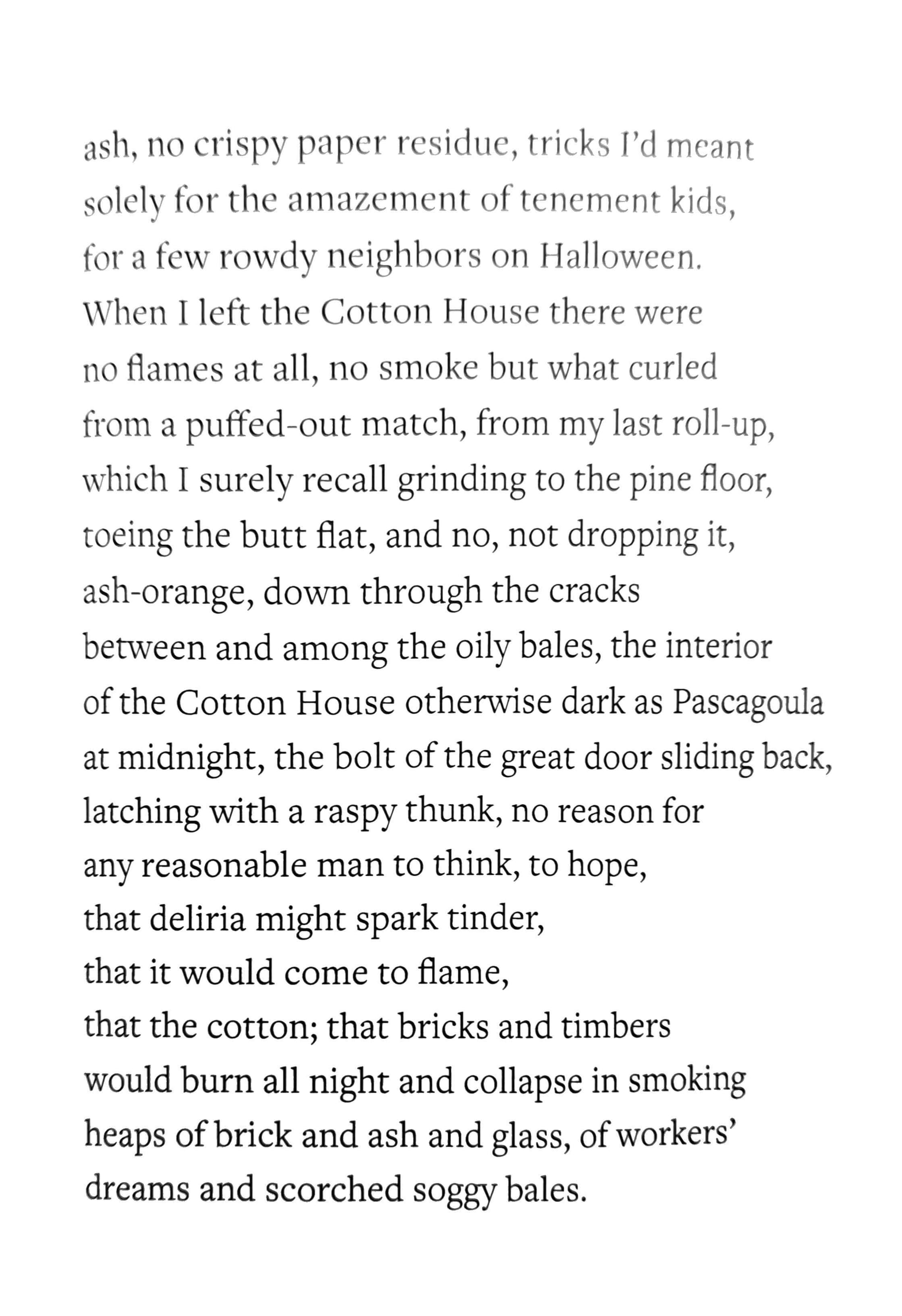
Alt-text of poem:
Cotton House Fire
October 29-30, 1915
True, how could they see anything but the shadows if they were never allowed to move their heads?
- Plato, Allegory of the Cave
I did not torch the Cotton House
at Pepperell Mill and you cannae prove
I was there after 9pm, drinking whiskey
from a flask atop the Pascagoula bales
we carted from the dock last week.
Let's say someone did have an oil lamp
and was rolling a smoke, with scraps
from a tobacco pouch and the French
wrappers Eddie brought back, Saturday last,
from Portland. Anyone could have bought
those. I say this in speculation and wonder,
as I know not a bona fide fact, have heard
but few nasty rumors, and anyway, did not
drop a lit cigarette, nor splatter lamp-oil
down among the bales. There's nada proof
I was sparking the magic-flashers
Eddie may have also picked up (so cheap!)
at Culp's Magic City, snapping the papers,
flitting them to air; to illumine, to light
up the Cotton House all sorcerer-like,
casting black shadows, phantasms, great
dark shapes, vastly horrific against the rafters
and brick walls, like a magic lantern show
exactly, like something from Plato's Allegory,
a book I did not read--it cannae be proven
I can read--the nitrocellulose
crackling, exploding, incandescent,
burning with a brilliant flash, leaving no
ash, no crispy paper residue, tricks I'd meant
solely for the amazement of tenement kids,
for a few rowdy neighbors on Halloween.
When I left the Cotton House there were
no flames at all, no smoke but what curled
from a puffed-out match, from my last roll-up,
which I surely recall grinding to the pine floor,
toeing the butt flat, and no, not dropping it,
ash-orange, down through the cracks
between and among the oily babes, the interior
of the Cotton House otherwise dark as Pascagoula
at midnight, the bolt of the great door sliding back,
latching with a raspy thunk, no reason for
any reasonable man to think, to hope,
that deliria might spark tinder,
that it would come to flame,
that the cotton; that bricks and timbers
would burn all night and collapse in smoking
heaps of brick and ash and glass, of workers'
dreams and scorched soggy bales.
I hope you find a book here you like or it leads you to one you do! Poetry is a wildly interesting world to get into and I strongly suggest digging through to find things that resonate with you. As promised, here’s my poem from the journal listed above. Please feel free to share poem/poetry books with my on Bluesky. I will 100% be interested. Always.
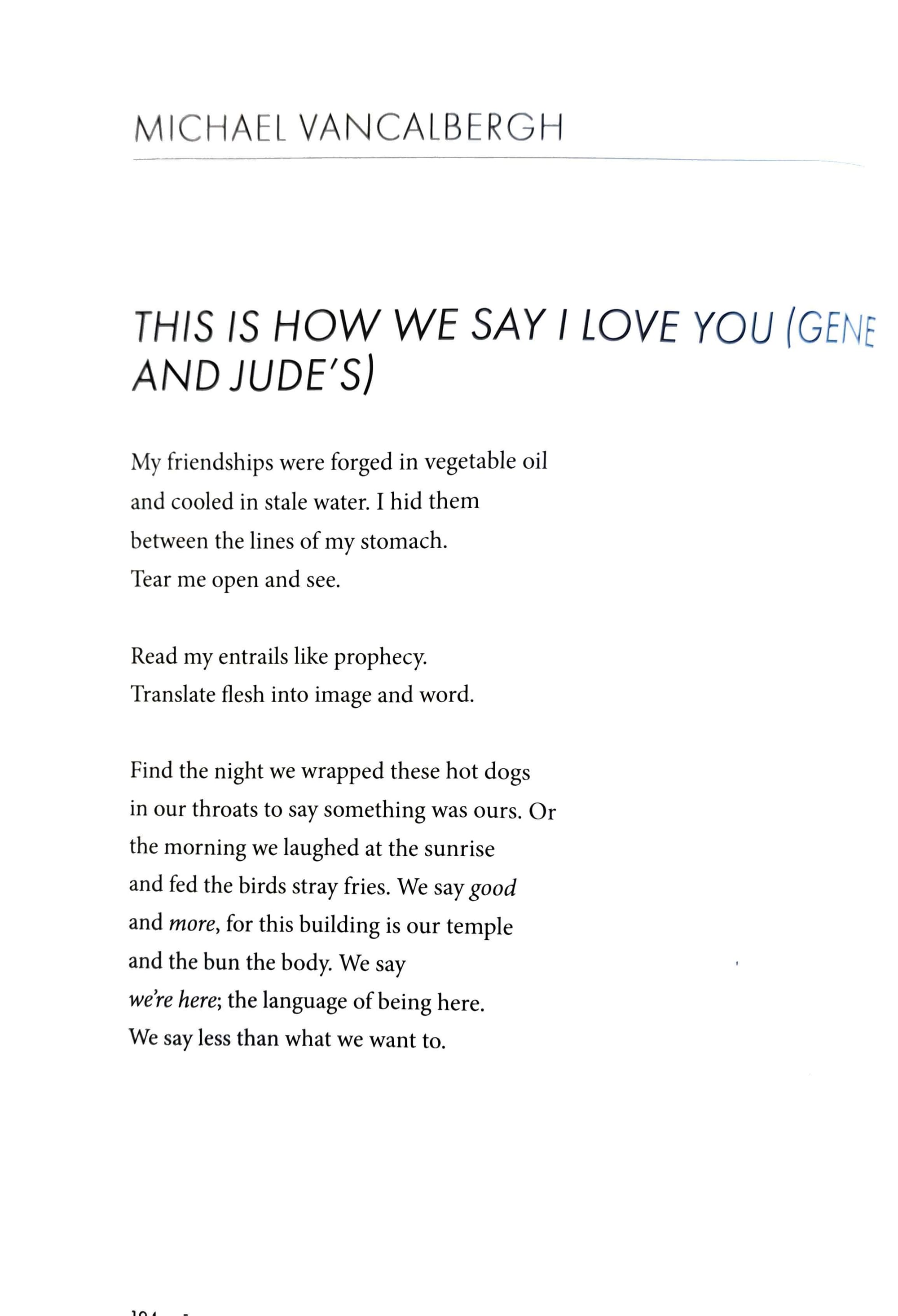
Alt-Text of Poem
This is How We Say I Love You (Gene and Jude's)
My friendships were forged in vegetable oil
and cooled in stale water. I hid them
between the lines of my stomach.
Tear me open and see.
Read my entrails like prophecy.
Translate flesh into image and word.
Find the night we wrapped these hot dogs
in our throats to say something was ours. Or
the morning we laughed at the sunrise
and fed the birds stray fries. We say good
and more, for this building is our temple
and the bun the body. We say
we're here, the language of being here.
We say less than what we want to.
Thank you so much for reading! If you're interested in more of my creative work, you can check out a short story I had published last month at Penumbric Magazine and a poem at Last Leaves.
As always if you liked this work please consider subscribing. It will always be free. If you feel inclined to donate (you can do so below on a one time basis!) or you can subscribe for $5 a month. This will help me buy more books and maybe even a bookshelf so I can stop stacking piles of books on my stairs and in random places in my kitchen.
 About the Author